Automotive Driver Monitoring Systems 2024: The Global Shutter RGB-IR Camera Breakthrough
Automotive Driver Monitoring Systems 2024: The Global Shutter RGB-IR Camera Breakthrough
By 2026, every new vehicle sold in the European Union must watch the driver as intently as the driver watches the road. As regulatory deadlines loom, a quiet revolution in automotive driver monitoring systems is underway—one that pits legacy rolling-shutter cameras against a new generation of global shutter RGB-IR technology that could determine which automakers survive the transition.
The Regulatory Tsunami: Why DMS Is No Longer Optional
The EU’s General Safety Regulation (GSR) 2019/2144 is not just another bureaucratic checkbox. Starting July 2024 for new models and July 2026 for all new vehicles, advanced driver distraction warning systems are mandatory. According to Reuters, this has triggered a supply chain scramble that has left some Western OEMs scrambling for component suppliers while Chinese EV makers exploit a twelve-month technological lead.
Meanwhile, the U.S. is not far behind. The NHTSA’s renewed scrutiny of Level 2 autonomous systems following multiple Tesla investigations has made robust driver monitoring a de facto requirement for any manufacturer seeking top NCAP safety ratings. Bloomberg reports that Chinese EV manufacturers have already leapfrogged Western competitors in this domain, deploying sophisticated in-cabin AI that Western regulators now view as the benchmark for compliance.
Technical Deep Dive: e-con Systems’ STURDeCAM57
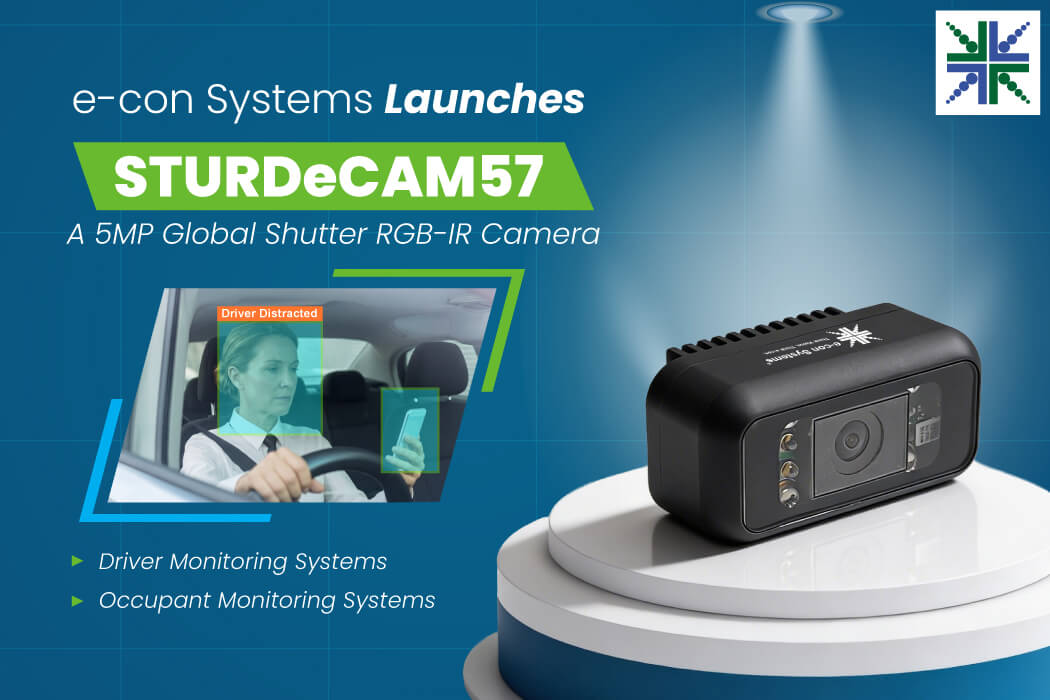
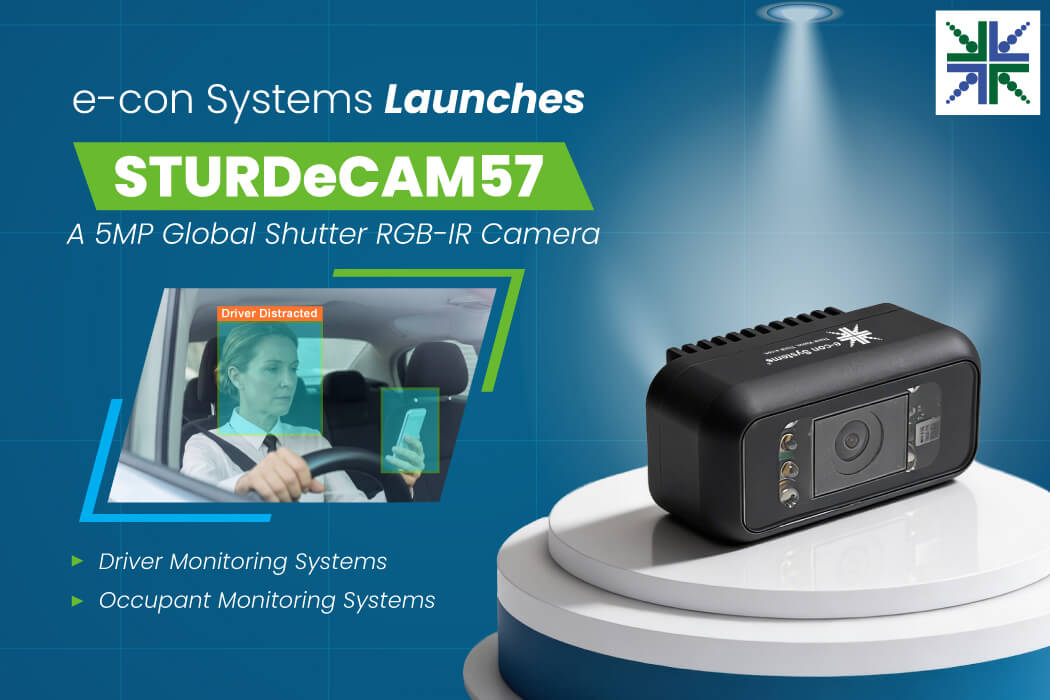
Enter e-con Systems’ STURDeCAM57, a 5MP global shutter RGB-IR GMSL2 camera that represents a paradigm shift in how automotive driver monitoring systems capture data. Unlike conventional rolling-shutter cameras that capture images line-by-line—creating motion blur when tracking rapid eye movements—global shutter technology captures the entire frame simultaneously.
Why Global Shutter Matters for Safety
In a fatigue-detection scenario, a driver’s eyelid can move in milliseconds. Rolling-shutter sensors often produce distorted jello effects during these critical moments, potentially missing the micro-sleeps that precede accidents. The STURDeCAM57’s global shutter ensures crisp capture of these split-second events, directly addressing the stringent requirements of EU GSR for direct driver monitoring without mechanical latency.
The RGB-IR Fusion Advantage
Traditionally, automotive OEMs required separate RGB cameras for daylight operation and IR cameras for nighttime monitoring, often with mechanical IR-cut filters that added failure points and maintenance costs. The STURDeCAM57 eliminates this complexity by streaming both RGB and infrared frames simultaneously as independent channels through a single GMSL2 interface.
- Single-Sensor Architecture: Reduces bill-of-materials costs while improving MTBF (Mean Time Between Failures) reliability ratings essential for automotive Tier 1 suppliers
- Onboard ISP Processing: The camera’s integrated Image Signal Processor handles RGB-IR separation and demosaicing internally, freeing NVIDIA Jetson host platforms to focus on AI inference rather than image preprocessing—critical for edge computing architectures
- Environmental Hardening: IP67 rating and -40°C to 85°C operating range exceed typical interior camera specifications, suggesting potential for exterior occupant safety applications
- Stream Health Monitoring: Built-in diagnostics for sensor, ISP, and GMSL link integrity ensure compliance with automotive functional safety standards
The China Factor: How Beijing’s EV Giants Are Setting the Standard
While Western regulators scramble to mandate basic monitoring, Chinese EV makers like BYD, NIO, and Xiaomi have already normalized cabin-facing cameras with advanced infrared capabilities. CNBC reported in February 2024 that Chinese consumers now expect DMS as a standard feature, not a luxury option—creating export vehicles that arrive in Europe with superior safety tech than local competitors.
This creates a competitive asymmetry dangerous to legacy automakers. When BYD launches a vehicle with continuous biometric monitoring capable of detecting not just distraction but emotional states and medical emergencies, the bar for safety rises globally. Western automakers relying on legacy camera architectures risk appearing technologically antiquated in markets where Chinese EVs are gaining traction—particularly Southeast Asia and Europe.
The NVIDIA Ecosystem Play
The STURDeCAM57’s optimization for NVIDIA Jetson platforms is strategically significant. As automakers migrate from distributed ECUs to centralized compute architectures—exemplified by NVIDIA’s DRIVE Thor and Qualcomm’s Snapdragon Ride—peripheral devices that offload processing tasks become critical supply chain assets. By handling RGB-IR separation on-camera, the STURDeCAM57 reduces bandwidth requirements and computational load on the central processor.
For investors, this signals a shift toward smart sensors in the automotive supply chain, moving value from traditional Tier 1 integrators to specialized vision technology firms. See our analysis on NVIDIA’s automotive chip dominance and the China EV ecosystem for deeper insight into this supply chain evolution.
Investment Implications: Beyond the Component
The global automotive driver monitoring systems market is projected to exceed $4.5 billion by 2027, driven largely by regulatory mandates. However, the technology divergence is clear: mechanical IR-cut filters and rolling-shutter sensors represent legacy architectures being rapidly deprecated, while solid-state global shutter RGB-IR cameras represent the new compliance standard.
Western automakers still relying on older technologies face not just regulatory compliance risks but consumer perception challenges. As Chinese EVs with superior cabin monitoring enter European markets—backed by aggressive pricing and local production—the technical specifications of in-cabin cameras could become a key differentiator in showroom comparisons, much like battery range became the metric for EV credibility.
Recommended Reading
For readers seeking to understand the broader context of how in-cabin AI and autonomous systems are reshaping mobility, we recommend Autonomous Driving: How the Driverless Revolution will Change the World by Andreas Herrmann and Walter Brenner. This comprehensive analysis explores the regulatory and technological forces converging in today’s automotive semiconductor market, providing essential context for investors evaluating the shift toward camera-based vehicle safety systems.
Conclusion: The Camera as Competitive Moat
The STURDeCAM57 is not merely a component launch—it represents the commoditization of advanced vision technology that was classified as experimental just three years ago. For Western investors and automotive executives, the message is clear: the era of treating driver monitoring as an afterthought is over. In the new regulatory reality, your camera architecture is your compliance strategy, and global shutter RGB-IR technology appears to be winning.
As Chinese EV makers continue to export vehicles equipped with sophisticated DMS capabilities, Western OEMs must accelerate adoption of next-generation camera technologies or risk ceding the safety narrative—and the market—to competitors who saw this transition coming.