China ADAS Supplier Market Share: Local Giants Now Dominate Critical EV Tech (2026 Data)
China ADAS Supplier Market Share Shift Signals Supply Chain Revolution
What if Western automakers could no longer source critical autonomous driving components from their traditional Tier 1 suppliers? According to exclusive January-February 2026 data from Gasgoo Automotive Research Institute, that future is already arriving. Chinese ADAS supplier market share has reached tipping points across multiple critical subsystems, with domestic players now controlling over 92% of the air suspension market and dominating LiDAR, HD mapping, and high-precision positioning sectors.
This is not merely a procurement shift—it represents a fundamental restructuring of the global automotive supply chain that threatens to displace legacy European and American component giants.
The 92% Shock: How Local Suppliers Seized Air Suspension
Perhaps no statistic better illustrates the China ADAS supplier market share transformation than the air suspension segment. Once the exclusive domain of Continental, Vibracoustic (a Continental subsidiary), and other European specialists, the market has undergone complete localization.
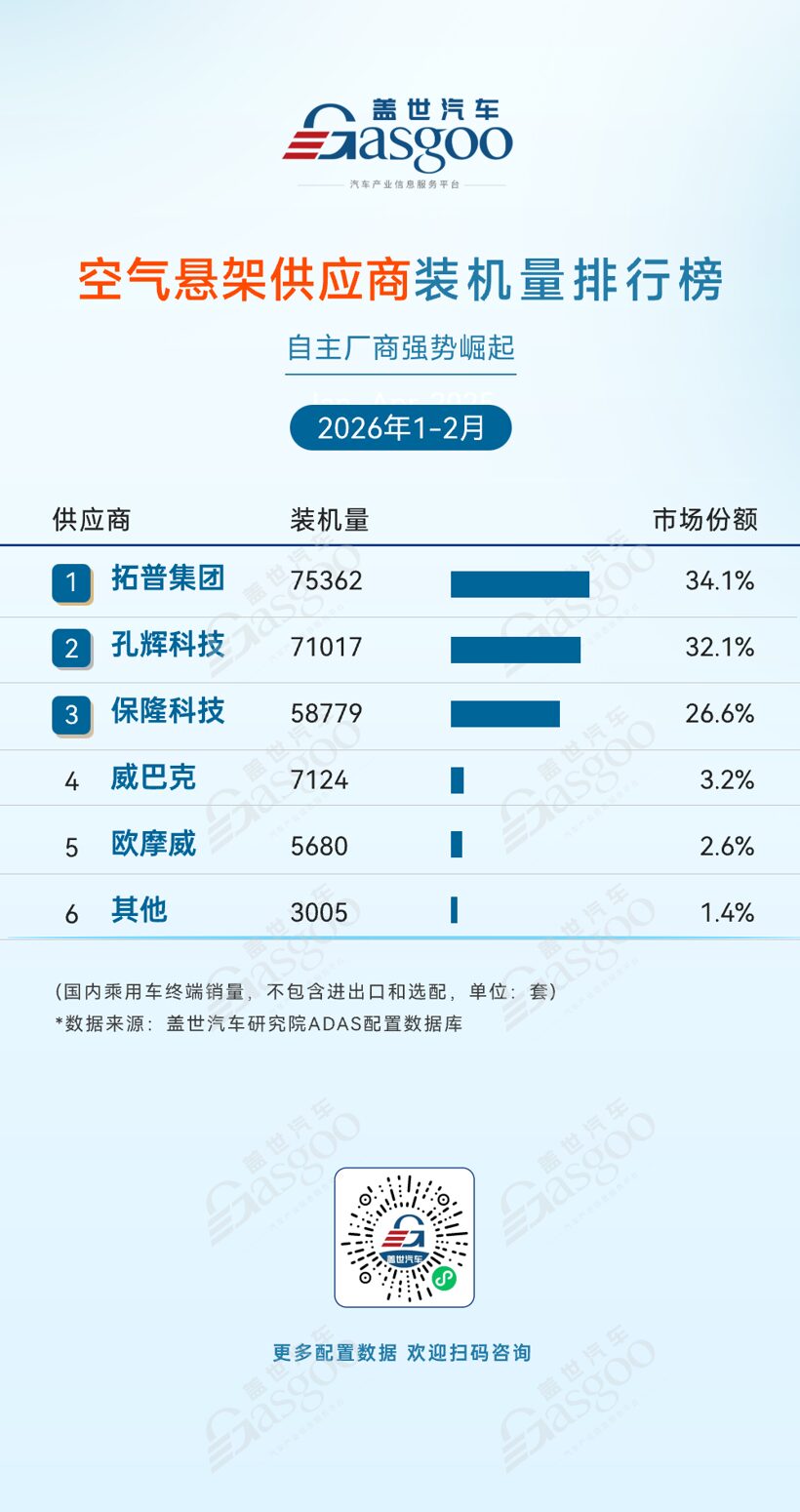
January-February 2026 Air Suspension Rankings:
- Tuopu Group: 75,362 units (34.1% market share)
- Konghui Technology: 71,017 units (32.1% market share)
- Baolong Technology: 58,779 units (26.6% market share)
- Vibracoustic: 7,124 units (3.2% market share)
- Others: 8,809 units (4.0% market share)
The top three Chinese vendors—Tuopu, Konghui, and Baolong—collectively command 92.8% of installations, effectively freezing out foreign competition. Reuters reports that this consolidation reflects years of government-backed localization initiatives meeting the scale requirements of BYD, Nio, and Li Auto.
Why Western Suppliers Lost Ground
The displacement stems from three factors: cost optimization (local vendors undercut European pricing by 30-40%), vertical integration (Tuopu supplies complete chassis systems), and regulatory preference for domestic supply chains in intelligent vehicle projects.
Beyond Suspension: Four Fronts of Chinese Dominance
The air suspension data point is not an isolated phenomenon. Gasgoo’s research identifies four critical autonomous driving component sectors where China ADAS supplier market share has flipped to domestic dominance:
1. LiDAR Systems
While Bloomberg notes Hesai and Robosense now supply the majority of sensors for Advanced Driver Assistance Systems (ADAS) in the Chinese market, Western players like Velodyne and Luminar struggle to achieve scale.
2. High-Definition Mapping
Due to data security regulations, foreign mapping providers face de facto exclusion, creating captive markets for Baidu, Tencent, and specialist firms like NavInfo.
3. High-Precision Positioning
BeiDou ecosystem companies dominate this sector, leveraging China’s satellite navigation infrastructure.
4. Computing Hardware
See our analysis on Chinese automotive chip localization strategies to understand how this extends to silicon.
The Foreign Strongholds: Where Global Tier 1s Still Lead
Despite the localization wave, international giants maintain advantages in three areas—though their moats are narrowing:
- Traditional ADAS Integration: Bosch, Continental, and Mobileye (Intel) still lead overall ADAS system integration
- Front-Facing Cameras: Foreign suppliers retain approximately 60% market share in premium segments
- Automated Parking (APA): Valeo and Bosch dominate complex multi-sensor fusion systems
However, local firms are accelerating penetration in these segments, with companies like DJI Automotive and Huawei HI (Huawei Inside) gaining traction.
Investment Implications: Why This Matters to Western Markets
For Western investors and automotive executives, the China ADAS supplier market share data signals three critical shifts:
Supply Chain Displacement Risk: Traditional Tier 1 suppliers face permanent market share loss in the world’s largest EV market. As Financial Times analysis suggests, this threatens revenue bases that have subsidized global R&D budgets.
Technology Standard Bifurcation: Chinese EV architectures increasingly rely on domestic component ecosystems incompatible with Western supplier roadmaps, potentially creating parallel standards.
Export Competition: As Tuopu and Konghui achieve scale domestically, they are beginning to export to European EV manufacturers seeking cost advantages, threatening premium pricing power of established suppliers.
Recommended Reading
To understand the broader context of this supply chain transformation, we recommend The Power Surge: Inside the Global Battle for Batteries, Chips, and EV Dominance by Simon Mundy (Financial Times, 2024). This essential analysis examines how China’s vertical integration in EV components—from semiconductors to suspension systems—is reshaping global automotive geopolitics.