
Toyota Joins Daimler-Volvo Fuel Cell Venture: A Strategic Shift in Heavy-Duty Trucking
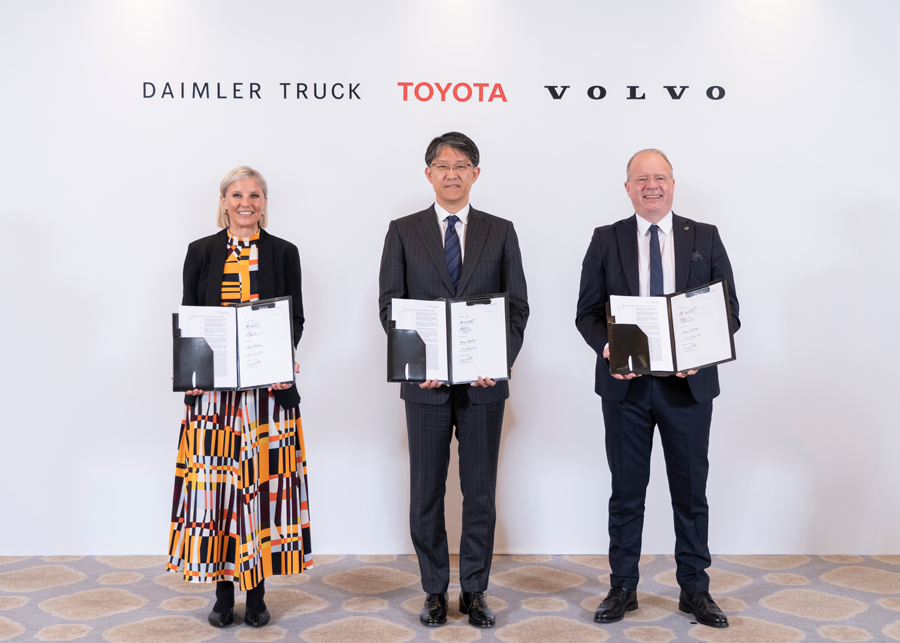
What if the future of long-haul trucking is not batteries, but hydrogen? On March 31, the Toyota Daimler Volvo fuel cell partnership took a definitive shape as Toyota Motor Corporation announced its entry into cellcentric, the fuel cell joint venture originally formed by Daimler Truck and Volvo Group. This rare transcontinental consolidation signals a strategic pivot toward hydrogen standardization for heavy-duty trucking, directly addressing Western concerns over China’s tightening grip on global battery supply chains.
Reuters reported that the non-binding agreement establishes Toyota as the third equal partner in the venture, alongside Daimler Truck and Volvo Group. Unlike the battery electric vehicle race where Chinese manufacturers currently dominate raw material refining and cell production, this alliance positions hydrogen fuel cell technology as a viable alternative path to decarbonization for heavy commercial transport.
The Cellcentric Expansion: From European Duo to Global Trio
Cellcentric, launched initially as a 50-50 joint venture between Daimler Truck and Volvo Group in 2021, serves as the technical hub for developing fuel cell systems for heavy-duty applications. With Toyota’s entry, the partnership transforms into a three-way collaboration with equal stakes, significantly broadening the technological base and geographic reach.
Toyota’s Strategic Contribution
Toyota brings over three decades of fuel cell research and manufacturing expertise, primarily honed through its Mirai passenger vehicle program. Bloomberg’s analysis notes that Toyota will co-develop fuel cell stacks, the core power generation units, alongside cellcentric, integrating its production expertise with the venture’s commercial vehicle focus. This represents a strategic pivot for Toyota, applying its passenger car hydrogen knowledge to the heavy-duty sector where European manufacturers hold sway.
‘We are proud that Toyota plans to join cellcentric as a shareholder,’ stated Karin Rådström, CEO of Daimler Truck. ‘This will allow us to intensify development and further scale hydrogen technology, which we believe can complement battery electric in the decarbonization of transportation.’
Circumventing China’s Battery Dominance
For Western investors and policymakers, this alliance carries significance beyond mere technology sharing. It represents a deliberate attempt to decouple heavy-transport decarbonization from China’s battery supply chain monopoly.
The Supply Chain Security Dimension
See our analysis on China’s EV supply chain dominance and Western counter-strategies. While lithium-ion batteries depend on Chinese-controlled rare earth processing and cobalt supply chains concentrated in Africa but processed in Asia, hydrogen fuel cells utilize platinum group metals and industrial hydrogen production that can be localized in North America and Europe. Financial Times highlights that this geographic diversification offers strategic resilience against supply disruptions.
Technical Advantages for Heavy-Duty Applications
Battery electric trucks face significant limitations in long-haul logistics: weight penalties that reduce payload capacity, extended charging times that disrupt fleet utilization, and range anxiety on transcontinental routes. Fuel cell electric vehicles offer refueling times comparable to diesel and consistent range regardless of load weight, making them theoretically superior for heavy-duty, long-distance freight operations.
Commercialization Roadmap and Infrastructure
The partnership aims to establish cellcentric as the primary technology supplier for fuel cell systems across all three manufacturers’ heavy-duty truck lineups by the late 2020s. However, significant hurdles remain.
Production Scale and Cost Targets
The companies intend to leverage economies of scale through shared component procurement and standardized fuel cell stack designs. By combining Toyota’s manufacturing automation expertise with Daimler and Volvo’s commercial vehicle production volumes, cellcentric targets cost parity with diesel powertrains by 2030, though this depends heavily on green hydrogen price reductions.
The Hydrogen Infrastructure Challenge
Unlike battery charging networks, which can leverage existing electrical grids, hydrogen refueling requires entirely new infrastructure. Martin Lundstedt, President and CEO of Volvo Group, emphasized the collaborative imperative: ‘We very much look forward to cooperating with Toyota to accelerate the hydrogen landscape and create scale through cellcentric. This is an important signal to customers, suppliers, and other stakeholders.’
The alliance explicitly includes collaboration with industry associations and hydrogen supply chain partners to accelerate refueling station deployment along major European and North American freight corridors.
Investment Implications for Western Markets
For investors evaluating the EV transition, this partnership signals that the future of commercial transport will likely be bifurcated: batteries for urban delivery and regional hauls, hydrogen for long-distance heavy freight. This diversification strategy mitigates the risk of single-technology dependence while challenging China’s anticipated dominance in commercial vehicle electrification.
Koji Sato, President and CEO of Toyota Motor Corporation, framed the collaboration as complementary: ‘Cellcentric has deep expertise in the commercial vehicle business, while Toyota has over 30 years of fuel cell development experience in the passenger car field. By combining our strengths, we hope to create a global leading fuel cell system for heavy-duty commercial vehicles.’
Recommended Reading
For readers seeking deeper understanding of hydrogen’s role in the energy transition, we recommend The Hydrogen Economy by Jeremy Rifkin. While published in the early 2000s, its framework for understanding hydrogen as a decentralized energy carrier remains relevant to today’s supply chain diversification strategies. The book provides essential context for why major automakers are revisiting fuel cells as a geopolitical hedge against battery supply chain concentration.