AI Vehicle Crash Prediction: How SHIFT-Crash Physics AI Challenges Chinese EV Speed
AI Vehicle Crash Prediction: The End of the Simulation Bottleneck?
What if the biggest competitive advantage in the global EV race wasn’t battery chemistry or autonomous software, but the ability to crash-test a vehicle in seconds rather than days? At the 2026 SAE World Congress in Detroit, Luminary unveiled SHIFT-Crash, a Physics AI model that does exactly that—compressing whole-vehicle collision simulations from 10-12 hours to mere seconds while predicting deformation and stress fields with unprecedented accuracy. For Chinese EV manufacturers racing to dominate European and North American markets, this AI vehicle crash prediction breakthrough represents both an existential threat and a technological imperative.
See our analysis on how Chinese OEMs are adapting Western AI validation tools for strategic insights.
From Finite Elements to Infinite Speed: The SHIFT-Crash Technical Breakthrough
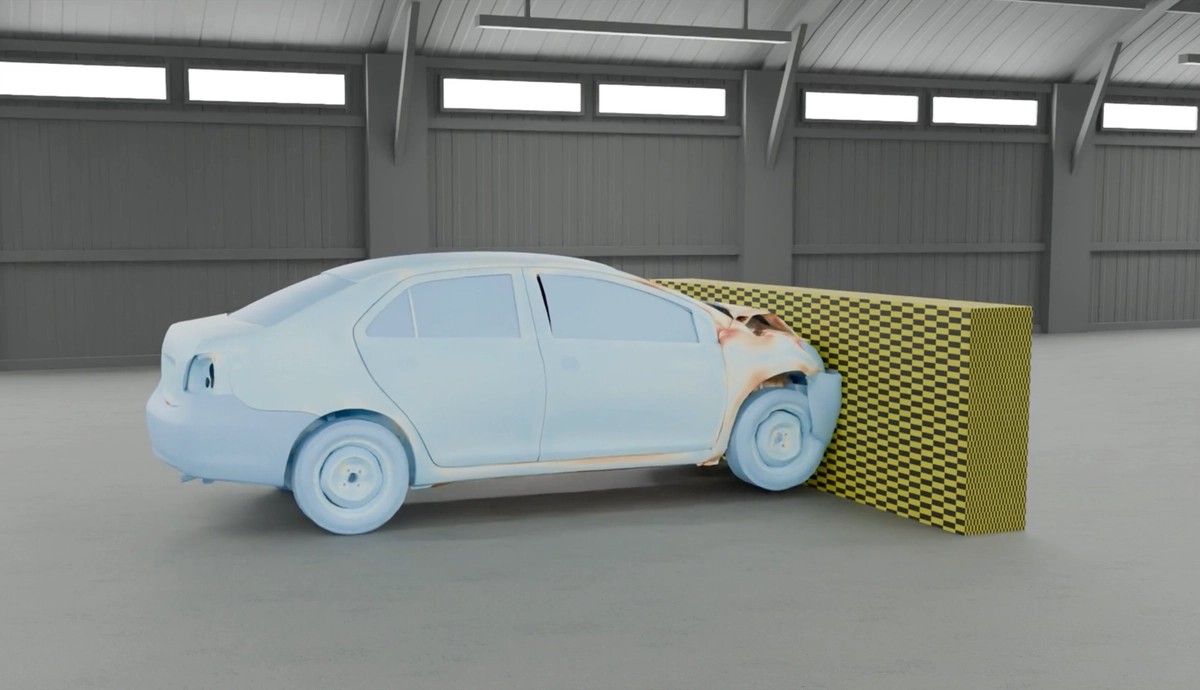
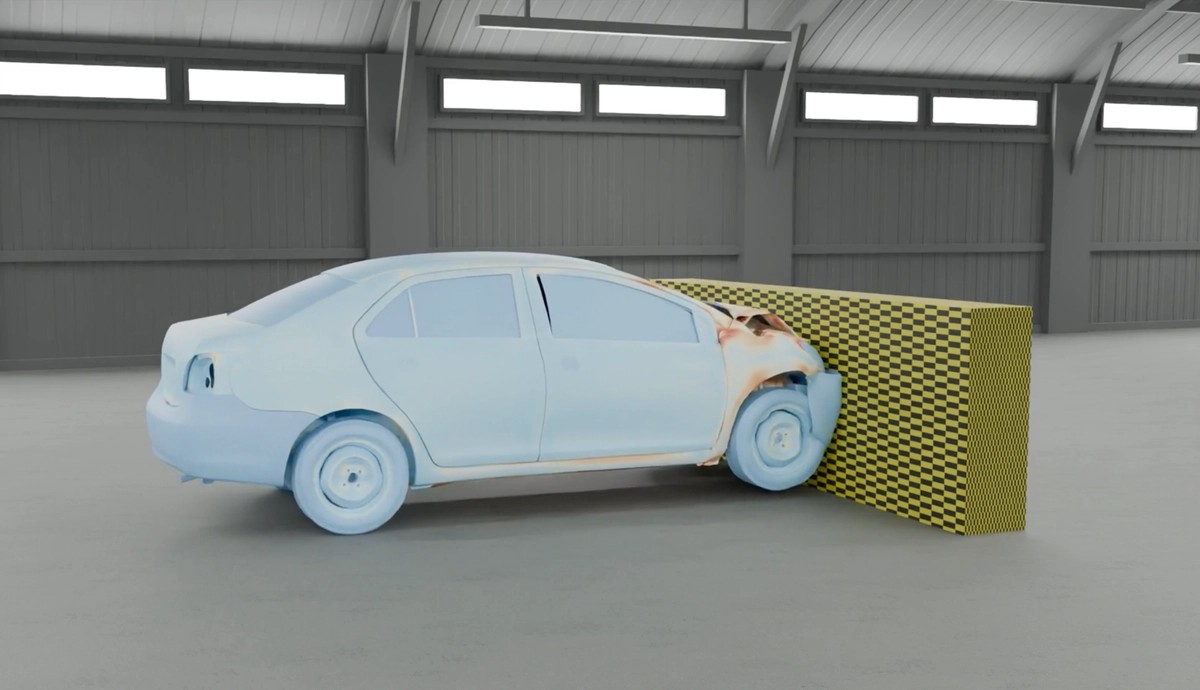
Traditional vehicle development relies on Finite Element Method (FEM) simulations that require massive High-Performance Computing (HPC) clusters. A single NHTSA NCAP 56 km/h frontal crash simulation typically consumes 10-12 hours of compute time, with thousands of iterations required across a vehicle program. The critical flaw? FEM has no memory—each new vehicle platform requires rebuilding meshes and running solvers from scratch.
Luminary’s SHIFT-Crash fundamentally rewrites this equation. Built on a dataset of 5,000 crash simulations from the 2010 Toyota Yaris, this is the first learnable surrogate model capable of capturing whole-vehicle crash dynamics within a multi-dimensional parameterized design space. Unlike traditional FEM, SHIFT-Crash retains and refines collision physics knowledge across vehicle projects, generating spatially resolved stress field predictions directly from design parameters.
- Speed: Seconds vs. hours for complete collision analysis
- Memory: Transferable physics knowledge across vehicle platforms
- Resolution: Full-field stress and deformation prediction
- Validation: Compatible with emerging virtual testing standards (see BMW Group’s February 2026 virtual validation approval)
The Chinese EV Market Implication: Erosion of the Speed Advantage
Chinese EV manufacturers like BYD, NIO, and XPeng have disrupted global markets through compressed development cycles—typically 18-24 months versus 36-48 months for legacy Western OEMs. However, this speed has relied heavily on parallel processing and aggressive physical prototyping, particularly for safety validation under Euro NCAP and IIHS protocols.
SHIFT-Crash threatens to neutralize this advantage. If Western automakers can now evaluate thousands of design iterations in the time it previously took to run one simulation, they can explore design spaces previously unreachable within program timelines. As one major OEM confirmed to industry sources, this capability allows engineers to optimize crash safety in early development phases—when design changes cost hundreds rather than millions of dollars.
Regulatory Arbitrage Risks for Chinese Exporters
With the EU’s 2026-2027 implementation of stricter pedestrian protection and side-impact standards, Chinese EVs face increasing scrutiny. Traditional simulation bottlenecks have forced many Chinese manufacturers to rely on late-stage physical testing, creating compliance risks. Physics AI models like SHIFT-Crash enable Western competitors to front-load safety optimization, potentially locking in superior NCAP ratings before Chinese competitors complete their validation cycles.
Strategic Analysis: Adoption Imperatives for Global Players
For Western investors monitoring the automotive technology sector, SHIFT-Crash signals a broader shift toward AI-native engineering tools. The technology aligns with BMW Group’s recent regulatory milestone—obtaining official German recognition for virtual crash test equivalence in February 2026—suggesting regulatory frameworks are evolving to accommodate Physics AI validation.
However, Chinese EV makers are not standing still. Industry sources indicate that CATL and Huawei’s intelligent automotive divisions are developing similar surrogate modeling capabilities, though these remain proprietary and platform-specific. The open, reusable nature of Luminary’s approach—where accumulated physics knowledge transfers between vehicle programs—may prove more economically scalable than closed Chinese systems.
Investment and Market Outlook
The commercial implications extend beyond R&D efficiency. OEMs leveraging AI vehicle crash prediction can:
- Reduce HPC infrastructure costs by 80-90% for safety validation
- Accelerate time-to-market by 3-6 months on new platforms
- Meet evolving Euro NCAP 2026 and IIHS protocols with greater design confidence
For Chinese EV stocks listed on NASDAQ and HKEX, the risk is clear: if Physics AI becomes the standard for safety validation, the capital efficiency gap between Chinese and Western engineering processes narrows dramatically. Investors should monitor partnerships between Chinese OEMs and AI simulation providers, as in-house development cycles may prove too slow to match Luminary’s accumulated learning advantage.
Conclusion: The New Physics of Competition
Luminary’s SHIFT-Crash doesn’t merely optimize existing workflows—it eliminates the computational constraints that have shaped automotive development for decades. For Chinese EV manufacturers, the choice is stark: adopt transferable Physics AI capabilities rapidly or watch their development speed advantage evaporate in the face of Western regulatory and technological convergence. As virtual validation becomes legally equivalent to physical testing, the winners in the next phase of the EV revolution will be those who can crash cars in milliseconds, not days.
Sources: Luminary Technical Briefing (SAE World Congress 2026), BMW Group Regulatory Communications (February 2026), and Bloomberg Automotive Intelligence.