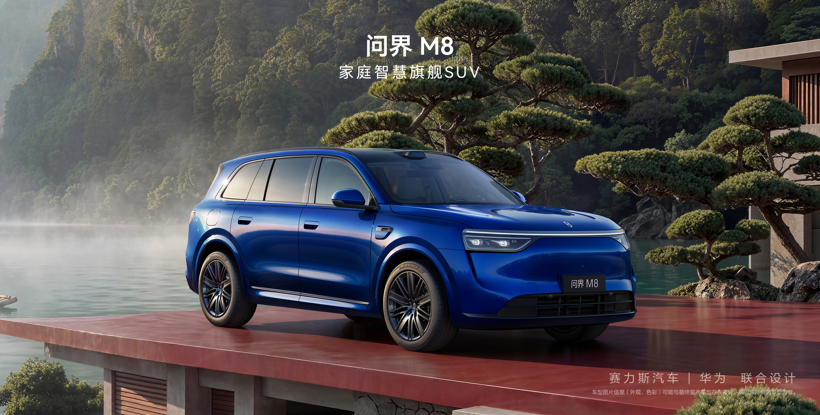
What happens when a tech giant completely replaces the traditional automotive Tier 1 supply chain? The AITO M8 is not merely another premium SUV launching in China—it represents a fundamental shift in how intelligent vehicles are architected. With over 150,000 units delivered in 2025 alone and a refreshed edition scheduled for March 2026, this 400,000 RMB ($55,000) ‘8 Series’ competitor is rewriting the rules of luxury automotive manufacturing. Our comprehensive AITO M8 supply chain analysis reveals exactly how Chinese vertical integration is threatening legacy German dominance in the ADAS component market.
See our analysis on Huawei’s automotive ecosystem strategy and vertical integration approach
The 400,000 RMB Battleground: Why This Segment Matters
The 35-45 million RMB ($48,000-$62,000) Extended Range Electric Vehicle (EREV) segment represents one of China’s most stable growth corridors. Market volume reached nearly 200,000 units in 2025 and is projected to hit 300,000 in 2026, according to industry data. This positions the AITO M8 directly against the BMW X5 Long Wheelbase and Mercedes-Benz GLE—but with a crucial technological divergence.
While German luxury still relies on Bosch, Continental, and ZF for ADAS modules, AITO leverages Huawei’s full-stack self-developed intelligent ecosystem. As Reuters reported on Chinese EV makers encroaching on premium territory, the battleground has shifted from engine displacement to sensor count and AI compute power.
The New Luxury Customer: Tech Equity Over Heritage
The core demographic has shifted dramatically from traditional luxury buyers to ‘quality families’ seeking ‘tech equity’—consumers demanding full-scenario intelligent experiences fused with ride comfort. These buyers prioritize HarmonyOS ecosystem integration over traditional brand prestige, creating an opening for Huawei-powered vehicles to capture market share historically dominated by German imports.
Supply Chain Deep Dive: The Huawei ADAS 4.1 Hardware Architecture
The refreshed M8’s most significant threat to Western Tier 1 suppliers lies in its perception hardware stack. Unlike European luxury vehicles still transitioning to multi-sensor fusion, Huawei’s ADAS 4.1 system deploys a staggering 36 sensors—effectively obsoleting the distributed ECU architecture favored by legacy OEMs:
-
1x 896-line LiDAR: High-resolution long-range detection for highway piloting
-
3x Solid-state LiDARs: Short-range precision for urban navigation and parking
-
9x Millimeter-wave radars: All-weather redundancy complementing optical sensors
-
12x Ultrasonic sensors: Close-range obstacle detection and automated parking
-
11x HD cameras: Visual perception backbone supporting Huawei’s computer vision algorithms
This configuration enables 360-degree coverage and ‘parking space to parking space’ autonomous navigation—functionality that Mercedes only recently secured permits for in China, as noted by Bloomberg, while Huawei’s system already achieves comparable capability through software-defined approaches.
Computing Stack: From Rule-Based to Generative AI
Beyond raw sensor count, the M8 integrates Huawei’s self-developed computing platform running the Pangu Large Language Model (LLM) for proactive scene-based services. This represents a generational leap from rule-based to AI-driven decision making—a technological transition that Reuters covered regarding Huawei’s broader AI ambitions.
The system processes inputs through Huawei’s custom silicon rather than NVIDIA or Mobileye platforms, creating a fully closed-loop supply chain that captures margin previously allocated to foreign semiconductor vendors.
Powertrain Localization: CATL and the 800V Platform
The M8’s 800V high-voltage architecture reveals strategic partnerships that further insulate the supply chain from Western vendors:
-
Battery Technology: CATL ternary lithium battery packs providing 310km CLTC electric range and 1,526km combined range—eliminating Korean or Japanese cell suppliers from the bill of materials
-
Powertrain: 1.5T dedicated range-extender engine with dual-motor AWD delivering 392kW and 5.2-second 0-100km/h acceleration
-
Chassis Intelligence: Huawei Tuling Intelligent Chassis integrating air suspension, adaptive damping, and torque vectoring through proprietary control algorithms
Implications for Western Investors: Three Critical Threats
This AITO M8 supply chain analysis reveals three structural trends threatening incumbent automotive suppliers:
-
Tier 1 Disintermediation: Huawei’s vertical integration bypasses traditional Bosch/Continental ADAS modules, capturing 15-20% of vehicle BOM value previously exported to European suppliers. For investors holding legacy auto supplier stocks, this represents a permanent margin compression risk.
-
Development Velocity Gap: The refreshed model incorporates generative AI (Pangu LLM) and next-generation solid-state LiDARs faster than German 48-month development cycles. Bloomberg notes that Chinese EV exports continue hitting records despite EU tariffs, suggesting these supply chain advantages translate globally regardless of trade barriers.
-
Software-Defined Substitution: By controlling the HarmonyOS 4.0 cockpit, ADAS 4.1 compute stack, and cloud-connected AI models, Huawei creates switching costs that legacy OEMs cannot match without complete architecture overhauls.
The Cockpit Experience: Nappa Leather Meets Neural Networks
The interior reveals the same localization strategy applied to luxury appointments. The M8 features a 15.6-inch 2K central display, 16-inch passenger entertainment screen, and HUAWEI SOUND 19-speaker audio system—all running on HarmonyOS 4.0 with seamless multi-device coordination.
Rather than sourcing infotainment from Harman or Bosch, Huawei’s in-house development enables over-the-air updates that improve vehicle function years post-delivery—a capability mismatch for Western luxury brands still reliant on static hardware-defined architectures.
Conclusion: The New Premium Paradigm
The AITO M8 is not merely a vehicle launch—it is empirical evidence of China’s complete supply chain maturation in the autonomous driving era. For Western investors and automotive executives, the strategic implication is unambiguous: the premium SUV market is no longer defended by German engineering heritage alone, but by who controls the sensor stack, the AI training data, and the operating system layer.
Huawei has demonstrated ownership of all three. With the 2026 refreshed edition poised to further consolidate the 400,000 RMB segment, legacy OEMs must now choose between accelerating their own vertical integration or facing irrelevance in the world’s largest automotive market.