While Western automakers debate whether LiDAR is dead, Chinese EV makers are installing six of them on a single vehicle—and teaching them to think. The China EV ADAS system integration strategy unveiled at the Beijing Auto Show reveals a terrifying pivot from vanity metrics to ruthless efficiency, one that could render traditional Western component sourcing obsolete.
This isn’t just about hardware stacking anymore. According to Ouyang Minggao, academician at the Chinese Academy of Sciences, the competition for the 2026-2030 ‘15th Five-Year Plan’ period has shifted from single-technology breakthroughs to ‘overall technical system competition.’ The era of bragging about 0-60 times and battery range is over. The new battleground? Systemic integration of safety, efficiency, charging, and intelligence.
The Death of Vanity Metrics
Remember when Chinese EV marketing focused solely on range figures exceeding 1,000km or acceleration times under three seconds? Those days are finished. The new competitive vectors are granular and systems-based:
- Battery Intelligence: Moving beyond energy density to specific cold-weather discharge capabilities at -30°C
- Algorithm Architecture: DeepRoute’s 40-billion parameter foundation model compressing data closed-loop cycles from five days to 12 hours
- AI Agent Integration: Voice assistants that understand contextual nuance like ‘I’m a bit cold’ rather than rigid command structures
As Reuters noted in recent coverage, China’s EV market is transitioning from growth-at-all-costs to technical sophistication that prioritizes user retention through software.
Hardware Stacking Meets Silicon Sovereignty
The most visible manifestation of this shift is the compute arms race. At first glance, the new AITO M9 (Huawei-backed) appears to represent peak hardware excess with six LiDAR sensors—including one 896-line unit. But this isn’t specification vanity; it’s computational pre-positioning.
Consider the silicon strategy:
- Li Auto L9 Livis: Dual self-developed Mach 100 chips delivering 2,560 TOPS
- XPeng GX: Four proprietary Turing AI chips achieving 3,000 TOPS
- Legacy Approach: Previous reliance on NVIDIA Orin chips (254 TOPS per unit)
This vertical integration matters because Bloomberg reports that Chinese OEMs are designing chip architectures specifically for over-the-air (OTA) evolution. High compute headroom allows vehicles to improve years after delivery, transforming cars from depreciating assets into appreciating software platforms.
See our analysis on Chinese EV semiconductor sovereignty strategies for deeper technical breakdowns.
The Chassis Democratization Wave
Perhaps more disruptive than the AI race is the democratization of premium chassis technology. Technologies once reserved for Mercedes S-Class or Porsche Cayenne are now standard on 400,000 RMB (approximately $55,000) vehicles:
Line-by-Wire Revolution
XPeng’s GX features the world’s first mass-produced steer-by-wire system, while NIO’s ES9 and Li Auto’s L9 Livis preload hardware for L3 autonomy. These aren’t mechanical backups—they’re fully electronic control systems with redundancy for L4 preparation.
Active Suspension Goes Mainstream
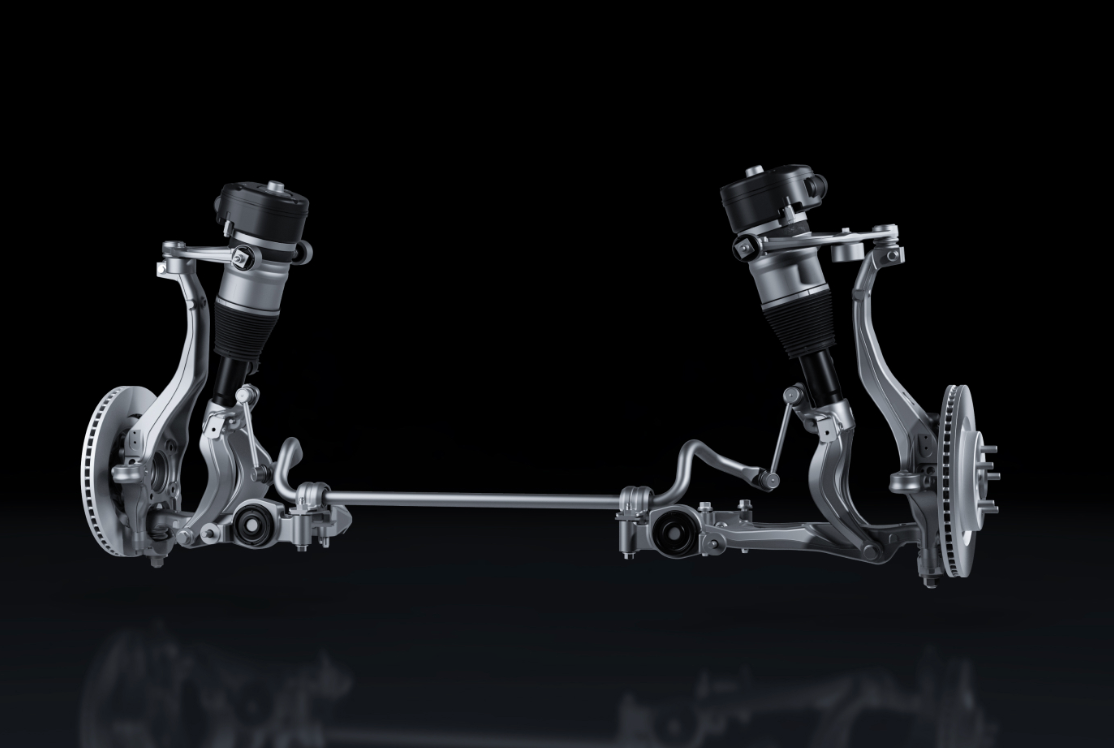
Ideal’s 800V fully active suspension and Huawei’s Tu Ling platform integrate Continuous Damping Control (CDC) with rear-wheel steering. The WEY V9X—a large SUV—offers ±10-degree rear steering, achieving a 5.1-meter turning radius tighter than many compact cars.
This represents a fundamental redefinition of vehicle architecture. The chassis is no longer passive mechanical infrastructure but an intelligent, software-defined system.
Algorithm Efficiency: The Real Moat
Hardware without intelligence is merely expensive decoration. The critical insight from Beijing is that Chinese firms are solving the ‘data digestion’ problem. DeepRoute’s deployment of a 40-billion parameter foundation model unifies driving, analysis, and evaluation capabilities under one architecture.
Why does this matter to Western investors? Because Tesla’s Full Self-Driving (FSD) has struggled with China’s complex urban environments, while local players are achieving 12-hour data iteration cycles. As the Financial Times observed, Chinese manufacturers are pivoting from hardware cost advantages to software ecosystem lock-in.
The Western OEM Existential Threat
For American and European automakers, this systemic integration poses an existential challenge. While Detroit and Stuttgart still debate tiered supplier relationships and LiDAR versus camera purity, Chinese OEMs are optimizing the entire signal chain—from sensor fusion to chip instruction sets to thermal management.
The -30°C battery discharge benchmarks aren’t just winter performance bragging; they’re proof of system-level thermal management that Western EVs struggle to match. When combined with AI agents that actually understand passengers and chassis that preload for autonomy, these vehicles represent integrated mobility platforms—not transportation appliances.
Conclusion: Benchmark or Perish
The six LiDARs on the AITO M9 aren’t a specification war escalation—they’re a statement of computational intent. China EV ADAS system integration has evolved from component sourcing to vertical optimization, creating efficiency moats that scale through software rather than manufacturing.
Western investors must understand: this isn’t a cost-cutting race to the bottom. It’s a systems engineering race to the top, and the finish line is 2026. If Western OEMs don’t begin benchmarking these integrated architectures immediately, they risk facing market entry requirements they cannot meet.