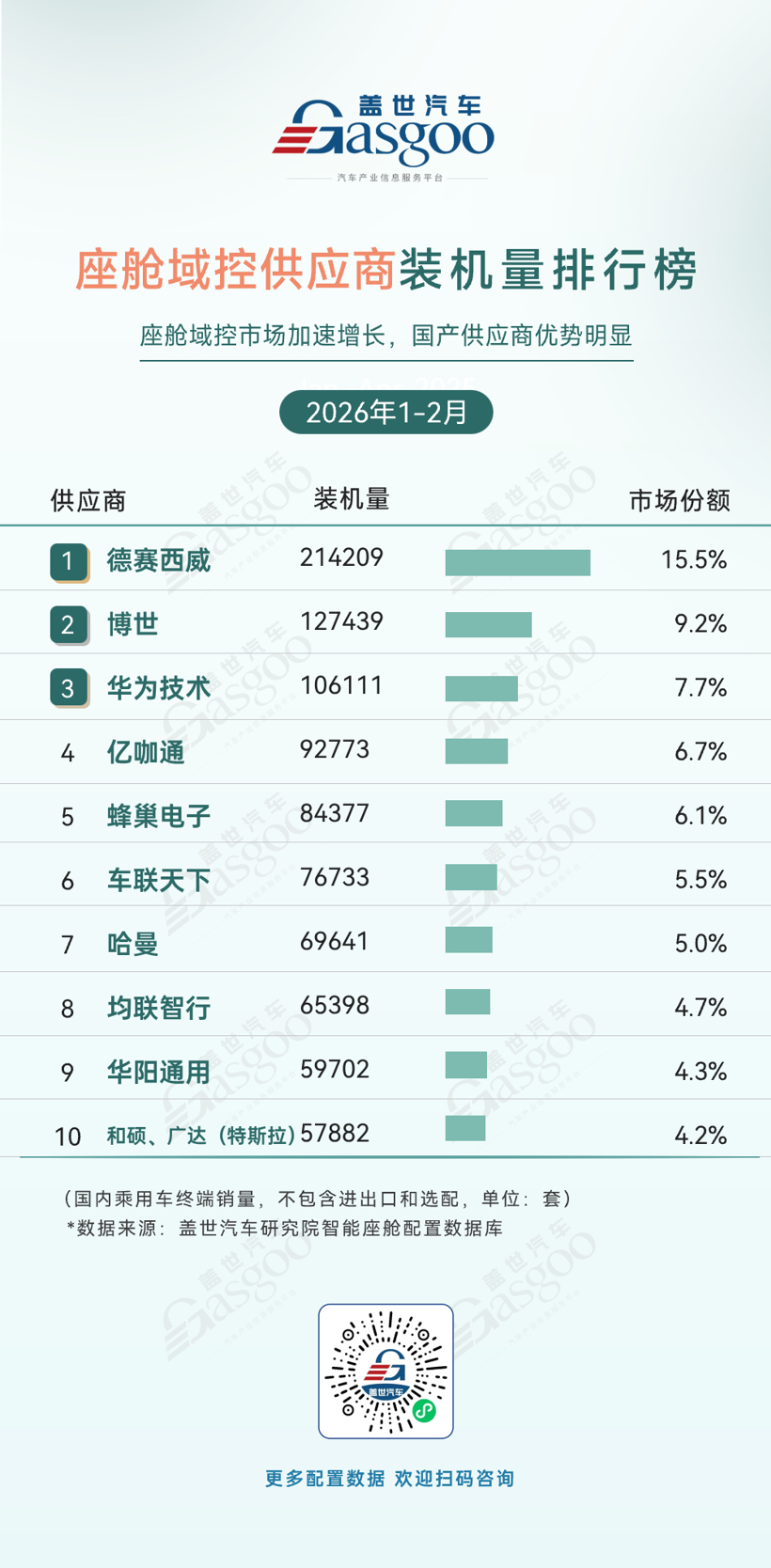
What if your next car’s digital brain was engineered in Shenzhen, not Stuttgart? According to January-February 2026 data from Gasgoo Automotive Research Institute, domestic Chinese suppliers are capturing unprecedented share in the smart cockpit supply chain, challenging decades of Western Tier-1 dominance.
The numbers reveal a seismic shift in China smart cockpit market share. In the cockpit domain controller segment, local giant Desay SV now commands 15.5% market share with over 214,000 units installed—nearly double the volume of second-place Bosch (9.2%). This represents more than a statistic; it signals the rapid localization of automotive intelligence as Huawei and local chipmakers leverage software-defined vehicle trends to displace incumbent hardware suppliers.
The Domain Controller Power Shift
Cockpit domain controllers—the central nervous system integrating displays, HUDs, and voice AI—have become the primary battleground for differentiation. The latest rankings reveal a market fragmenting along geopolitical lines:
-
Desay SV (15.5%): The Shenzhen-based supplier has leveraged its partnership with NVIDIA and Qualcomm to become the integration partner of choice for domestic EV brands.
-
Bosch (9.2%) vs. Huawei (7.7%): The gap between the German industrial giant and the Chinese tech conglomerate has narrowed to just 1.5 percentage points, with Huawei’s HiSilicon chips powering its end-to-end cockpit solutions.
-
Mid-tier consolidation: ECARX (6.7%), Hive Electronics (6.1%), and Carlink (5.5%) represent a new wave of OEM-backed suppliers capturing share from foreign incumbents.
Why Western Suppliers Are Losing Ground
Legacy Tier-1s like Bosch and Harman face a dual squeeze. First, Chinese OEMs increasingly require chip-to-cloud vertical integration that foreign vendors cannot provide due to localization mandates and US-China technology restrictions. Second, domestic suppliers offer 20-30% cost advantages while closing the quality gap. As one industry analyst noted, ‘The days when Western electronics commanded premium pricing in China are ending.‘
Semiconductor Localization: The Chip War Moves to the Cabin
While domain controllers tell one story, the underlying silicon reveals the true extent of disruption. Despite Qualcomm maintaining 72.1% share in cockpit chips (1.01 million units), the trajectory favors Beijing’s self-sufficiency goals.
Huawei and Siengine: The Domestic Challenge
Huawei’s chip division captured 7.9% of the market (110,972 units), while Siengine Technology (芯擎科技) hit 5.3%—primarily through Geely and Dongfeng deployments. These domestic alternatives, running on RISC-V and legacy SMIC processes, are proving sufficient for mainstream intelligent cockpit functions despite lacking leading-edge node access.
This aligns with Financial Times reporting on China’s automotive chip substitution strategy. While Qualcomm’s Snapdragon still powers premium experiences in Mercedes and BMW Chinese-market vehicles, domestic EV brands increasingly view foreign silicon as a supply chain risk rather than a premium feature.
Investment Implications: What Western Stakeholders Must Watch
For US and European investors, the China smart cockpit market share data (see our analysis on geopolitical risks in EV supply chains) exposes three critical vulnerabilities:
-
Margin Compression: As local suppliers capture volume in the world’s largest auto market, Western Tier-1s face permanent margin erosion in their most profitable segment.
-
Technological Bifurcation: The emergence of parallel Chinese cockpit ecosystems (Huawei HarmonyOS vs. Android Automotive) threatens to fragment global software standards.
-
Export Limitations: Foreign suppliers dependent on China revenue may find themselves caught in escalating technology sanctions, potentially freezing them out of the market.
The data suggests investors should scrutinize exposure to legacy automotive electronics. Companies like Harman (Samsung) and Bosch face structural headwinds not from cyclical downturns, but from permanent market share loss to subsidized, vertically integrated Chinese competitors.
Recommended Reading
To understand the semiconductor geopolitics driving these market shifts, we recommend Chip War: The Fight for the World’s Most Critical Technology by Chris Miller. This Pulitzer Prize-winning history explains how export controls and industrial policy are reshaping automotive supply chains just as surely as they have reshaped smartphones and servers.
Data source: Gasgoo Automotive Research Institute (Jan-Feb 2026). Market share figures represent cockpit domain controller and chip shipments to Chinese OEMs and joint ventures.