Did you know that the average premium electric vehicle in China now ships with more display real estate than a professional workstation? As cabin digitization becomes the new battlefield for automotive differentiation, Parade Technologies (NASDAQ: PSRV) has unveiled the PS8651V, an automotive DisplayPort controller that solves the critical bandwidth bottleneck facing pillar-to-pillar infotainment systems. This unassuming $3-5 chip represents a crucial chokepoint in the $50 billion vehicle semiconductor supply chain—one that Western investors are largely overlooking.
What Is the PS8651V and Why Does It Matter?
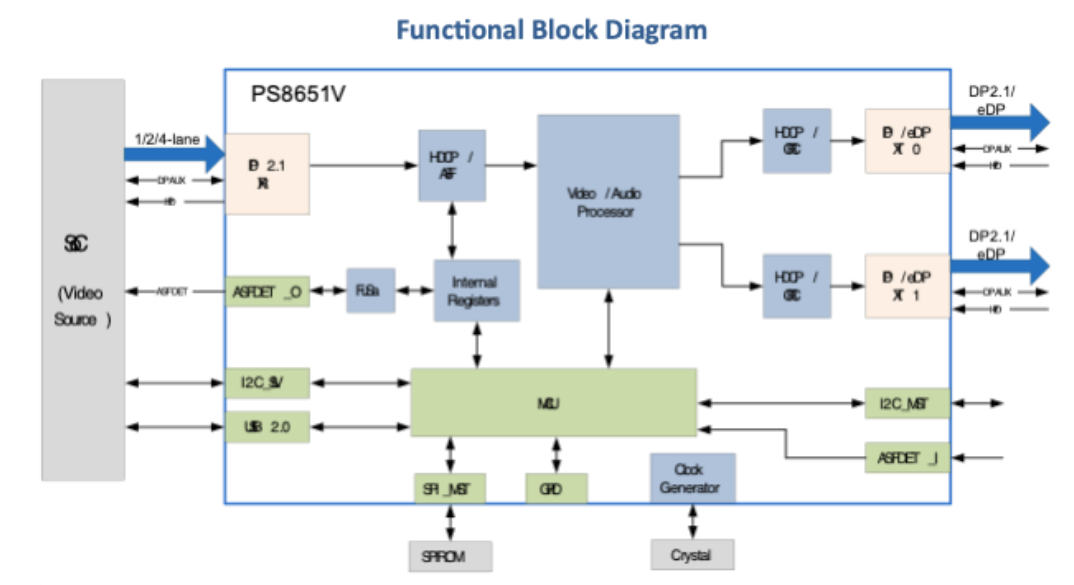
The PS8651V is a DisplayPort 2.1a/HBR3 1:2 Multi-Stream Transport (MST) hub controller designed specifically for automotive applications. Announced in early 2024, this AEC-Q100 Grade 2 certified chip enables a single video source to drive multiple displays simultaneously—a technical necessity for the panoramic screen arrays dominating Chinese EV design.
Key specifications include:
- Compliance: VESA DisplayPort v2.1a and embedded DisplayPort (eDP) 1.5 specifications
- Bandwidth: HBR3 link rates up to 8.1Gbps across four lanes
- Temperature Range: -40°C to +105°C (Grade 2 automotive qualification)
- Power Efficiency: Low-power architecture requiring no external heatsink—critical for thermal-constrained automotive environments
- Compression: Native VESA DSC 1.2a (Display Stream Compression) support for bandwidth-intensive 4K/8K panels
The Chinese EV Connection: Pillar-to-Pillar Displays
While Western automakers debate whether to add a second screen to the dashboard, Chinese EV manufacturers like BYD, NIO, and XPeng have moved aggressively toward pillar-to-pillar glass cockpits spanning 40+ inches. These configurations—which often integrate digital instrument clusters, central infotainment, and passenger entertainment into seamless ultra-wide displays—require sophisticated signal splitting and routing that legacy LVDS (Low-Voltage Differential Signaling) simply cannot support.
The PS8651V addresses this through MST (Multi-Stream Transport) capability, allowing a single DP cable to carry multiple independent video streams. In SST (Single Stream Transport) mode, it can split ultra-wide video frames across two separate panels—exactly the architecture required for the ‘pillar-to-pillar’ displays now standard in flagship Chinese EVs.
According to recent supply chain reports, Parade’s solutions are increasingly favored by tier-1 display module suppliers serving China’s EV giants, who demand the flexibility to mix DP and eDP protocols while minimizing wiring harness complexity.
Technical Deep Dive: Why MST Controllers Are Critical Infrastructure
For Western investors unfamiliar with display interface technology, the PS8651V represents a ‘picks and shovels’ play on the EV transition. Here’s the technical breakdown:
Multi-Stream Transport (MST) Architecture
Traditional vehicles use point-to-point video links. Modern smart cabins require network-like flexibility. MST enables daisy-chaining and hub-based architectures, reducing cable weight by up to 40% while supporting 3-5 independent displays from a single source.
Display Stream Compression (DSC) 1.2a
As displays migrate to 4K resolution with high refresh rates, uncompressed video would exceed DP 1.4 bandwidth limits. The PS8651V’s hardware DSC decoder allows visually lossless compression at 3:1 ratios, enabling 8K-equivalent bandwidth over standard cabling without electromagnetic interference (EMI) issues.
Automotive Qualification (AEC-Q100)
Consumer-grade chips fail in vehicles due to temperature cycling and vibration. The Grade 2 certification (-40°C to +105°C ambient) ensures reliability in engine-compartment-adjacent installations or sun-exposed dashboard positions.
Investment Implications: The Invisible Supply Chain
Parade Technologies occupies a lucrative niche in the automotive semiconductor value chain. While NVIDIA and Qualcomm capture headlines for autonomous driving chips, the ‘analog/mixed-signal’ layer—including display interface controllers, retimers, and touch controllers—generates gross margins exceeding 60% with significantly lower R&D intensity.
The PS8651V complements Parade’s existing PS8650 (1:4 MST hub) and integrates with their TC1316V touch controller and PS8461V DisplayPort retimer to create complete infotainment reference designs. This ecosystem approach creates switching costs for automakers—a moat that protects revenue as Chinese EV exports accelerate into Europe.
However, investors should note geopolitical risks. As the U.S. and EU scrutinize semiconductor supply chains, Parade’s Taiwan-based manufacturing (though fabless, using TSMC) faces potential regulatory headwinds should display controllers become classified as ‘critical automotive technology.‘
Competitive Landscape
Parade competes primarily with Texas Instruments (DAQ chipset), Analog Devices, and MegaChips in the automotive DP/eDP space. The PS8651V’s differentiator is its support for DP 2.1a at HBR3 speeds while maintaining compatibility with legacy eDP 1.5 touch panels—a crucial feature for automakers transitioning between display generations.
See our analysis on how BYD’s vertical integration strategy is reshaping automotive chip procurement to understand how Chinese OEMs are influencing component specifications.
Recommended Reading
For investors seeking deeper understanding of automotive display technology and the semiconductor value chain, we recommend ‘The Future of Automotive Semiconductors: Powering the Software-Defined Vehicle’ by Strategy Analytics. For technical depth on high-speed signal integrity, ‘High-Speed Digital Design: A Handbook of Black Magic’ by Howard Johnson provides essential context on the challenges Parade’s retimer technology solves.