What if the world’s largest supplier of smart cockpit domain controllers earned 92.6% of its revenue from a single country? This isn’t a hypothetical—it’s the paradox facing Desay SV Automotive, the Shenzhen-based automotive electronics giant that just filed for a Desay SV Hong Kong IPO to break out of its domestic cage.
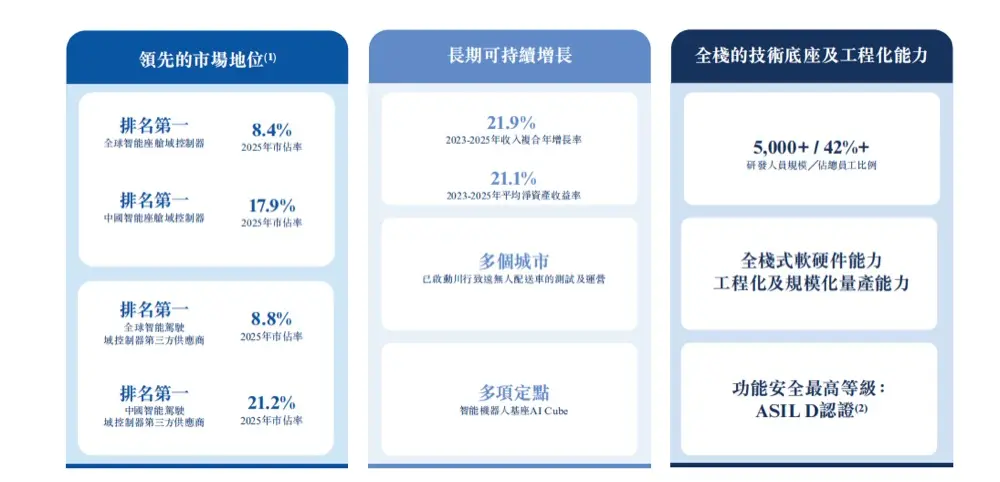
With a 21.2% market share in China’s intelligent driving domain controller space and an enviable roster including nine of the world’s top ten automakers, the Desay SV Hong Kong IPO represents more than a fundraising exercise. It’s a bid to transform from a ‘local champion’ into a global automotive semiconductor powerhouse before margin compression and customer concentration risks undermine its dominance.
The Numbers Behind the Desay SV IPO
According to its prospectus filed with Morgan Stanley and Huatai International as joint sponsors, Desay SV has posted impressive growth. Revenue surged from 21.9 billion yuan in 2023 to 32.6 billion yuan in 2025, representing a compound annual growth rate (CAGR) of 21.9%. Net profit climbed from 1.54 billion yuan to 2.47 billion yuan, with net margins improving from 7.0% to 7.6%.
Revenue Growth vs Margin Compression
However, beneath these headline figures lies a concerning trend for Western investors. While the company’s overall gross margin remained relatively stable at approximately 19.1% in 2025 (down slightly from 20.0% in 2023), its intelligent driving segment—a key growth driver—saw margins collapse from 19.9% to 16.4%. This suggests the company is buying market share through aggressive pricing in the highly competitive ADAS sector.
- Smart Cockpit Revenue: 20.6 billion yuan (63% of total)
- Intelligent Driving Revenue: 9.7 billion yuan (up 32.6% year-over-year)
- Operating Cash Flow: 2.88 billion yuan in 2025
Market Dominance in Domain Controllers
Desay SV’s technological position remains formidable. The company ranks first globally among third-party suppliers for intelligent driving domain controllers with an 8.8% market share, and commands a dominant 17.9% of China’s smart cockpit domain controller market. This dual leadership position makes the Desay SV Hong Kong IPO particularly attractive for investors seeking pure-play exposure to the software-defined vehicle transition.
Why Hong Kong? The Strategic Logic Behind Dual Listing
The decision to pursue an ‘A+H’ dual listing—maintaining its Shenzhen listing while adding Hong Kong—reflects broader geopolitical realities facing Chinese tech firms. As Reuters reported, increasing numbers of Chinese automotive semiconductor companies are turning to Hong Kong to access offshore capital amid ongoing US-China tensions that have complicated American depositary share (ADS) listings.
For Desay SV specifically, the Hong Kong listing serves three critical functions:
- Currency Flexibility: Raising hard currency for overseas acquisitions and European/North American expansion
- Valuation Arbitrage: Hong Kong listings often trade at premiums to mainland A-shares for technology exporters
- Geopolitical Hedge: Reducing reliance on single-market financing as US delisting threats persist for Chinese firms
The Concentration Risk Wall Street Can’t Ignore
Despite its global customer relationships—including Volvo, Volkswagen, and Toyota—the Desay SV IPO prospectus reveals alarming geographic concentration. In 2025, 92.6% of revenue originated from mainland China, with the top five customers accounting for 55.5% of total sales. The largest single client represented 14.5% of revenue.
Customer Dependency and Geographic Limits
This concentration creates vulnerability. As Bloomberg analysis suggests, China’s EV market is approaching saturation in the premium segment, leading to brutal price wars that compress component supplier margins. Desay SV’s margin decline in intelligent driving products likely reflects pricing pressure from domestic OEMs like Li Auto and NIO, which constitute major revenue sources.
Moreover, the company’s ‘global’ reach remains largely theoretical. While nine of the world’s top ten automakers are technically customers, the revenue contribution from Western markets remains minimal compared to domestic Chinese operations.
What This Means for Western Investors
The Desay SV Hong Kong IPO offers a unique entry point into China’s automotive semiconductor supply chain, but with significant caveats. Unlike NVIDIA or Mobileye, Desay SV represents a bet on Chinese EV ecosystem self-sufficiency—a double-edged sword as geopolitical decoupling accelerates.
See our analysis on Huawei’s automotive ambitions and the threat to tier-one suppliers for context on competitive pressures.
For portfolio managers, the key question isn’t whether Desay SV can maintain its technological edge—the company’s 21.1% three-year average ROE suggests operational excellence—but whether it can replicate its domestic dominance in European and North American markets before its growth engine stalls.
The IPO proceeds, estimated to raise between $500 million and $1 billion based on market rumors cited by Financial Times, will likely fund R&D centers in Germany and factory expansions in Southeast Asia. Success depends on convincing Western automakers to adopt Chinese-designed domain controllers for their global platforms—a proposition that remains politically and technically complex.
Bottom Line: Desay SV’s Hong Kong listing is a must-watch for automotive supply chain investors, but represents a high-risk, high-reward play on China’s ability to export automotive technology, not just batteries and EVs.