China’s 32Gbps Automotive SerDes Breakthrough Threatens Western Chip Dominance
China’s 32Gbps Automotive SerDes Breakthrough Threatens Western Chip Dominance
What if the backbone of your next electric vehicle’s 8K entertainment system owed nothing to Silicon Valley?
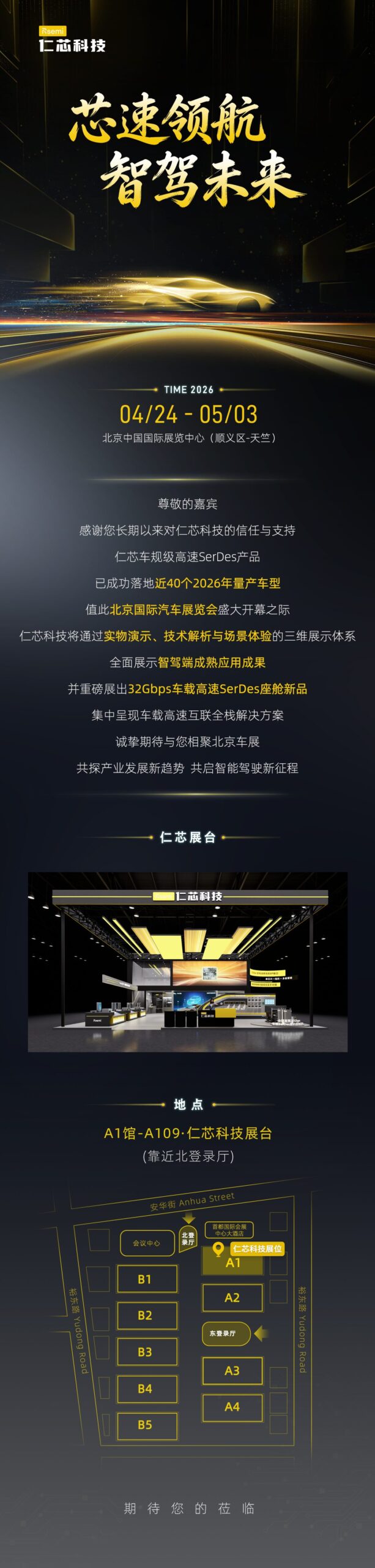
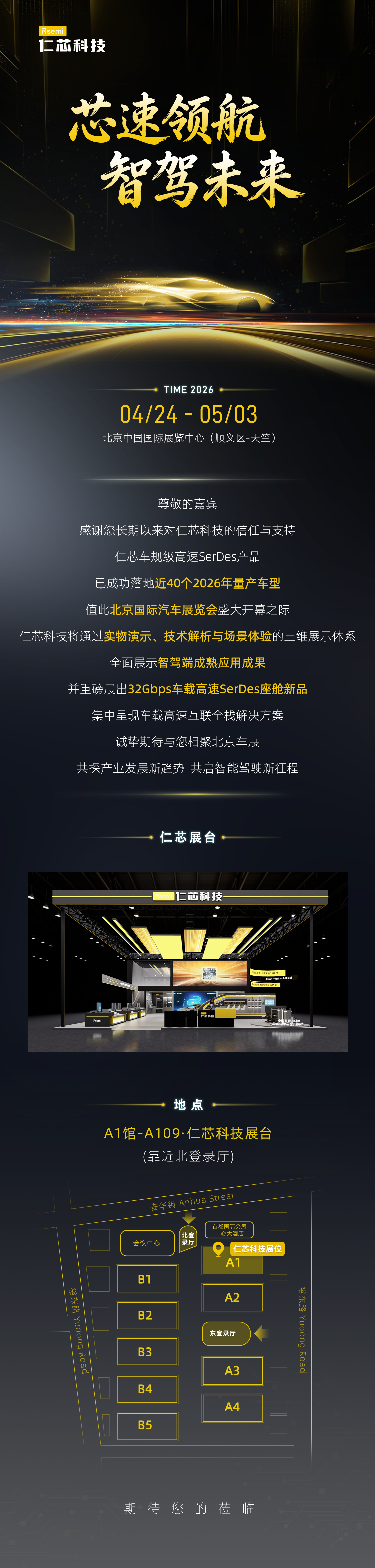
The 32Gbps automotive SerDes chipset unveiled by Renxin Technology at the 2026 Beijing Auto Show represents more than a technical milestone—it signals the most credible challenge yet to the analog semiconductor duopoly that has controlled vehicle data transmission for decades. As of Q1 2026, the Chinese chipmaker has already secured design wins across nearly 40 mass-production vehicle models, marking a critical inflection point in the localization of high-bandwidth automotive connectivity.
The Bandwidth Arms Race: Why 32Gbps Changes Everything
SerDes (Serializer/Deserializer) technology serves as the nervous system of modern vehicles, transmitting uncompressed video and sensor data between cameras, displays, and processors. Historically, this market has been dominated by Texas Instruments’ FPD-Link portfolio and Maxim Integrated (now Analog Devices) GMSL solutions, which typically max out at 12.88 Gbps for equivalent cockpit applications.
Renxin’s R-LinC platform achieves 32Gbps transmission rates—nearly triple the bandwidth of current Western alternatives. This capability enables:
- Lossless transmission of four concurrent 4K displays at 60Hz without compression artifacts
- Integrated functional safety and bridging capabilities that reduce cable harness complexity by up to 40%
- Direct support for next-generation 8K cockpit displays and Level 3+ autonomous sensor fusion
For context, Texas Instruments’ FPD-Link IV supports up to 12.88 Gbps over coaxial cable, while Analog Devices’ GMSL3 reaches similar speeds. As noted in Reuters’ recent analysis of automotive semiconductor trends, Renxin’s 32Gbps specification effectively leapfrogs existing standards, positioning Chinese firms at the bleeding edge of display interface technology.
Challenging the Analog Duopoly
The strategic significance extends beyond technical specifications. Western automakers and Tier 1 suppliers have long relied on a concentrated supply base for high-speed analog chips—a vulnerability exposed by recent supply chain disruptions and geopolitical tensions.
Renxin’s rapid commercialization demonstrates that Chinese semiconductor localization has evolved from aspirational policy to executable reality. The company’s ‘directly deployable’ system solutions indicate maturity in automotive qualification processes (AEC-Q100) and functional safety standards (ISO 26262), traditional barriers to entry for new market entrants.
See our analysis on China’s automotive semiconductor localization strategy and its impact on Western Tier 1 suppliers.
Production Reality: Scale Validates the Technology
By Q1 2026, Renxin had secured production slots across nearly 40 distinct vehicle models—a scale that suggests the technology has transcended pilot programs and entered mainstream adoption. This deployment velocity contrasts sharply with the typical 18-24 month qualification cycles common in automotive electronics.
According to Bloomberg’s coverage of China’s EV supply chain evolution, such rapid scaling indicates that domestic chipmakers are now competing on reliability metrics, not just cost advantages. The applications span both intelligent cockpit displays and advanced driver-assistance systems (ADAS), indicating the SerDes architecture meets stringent requirements for safety-critical applications.
Implications for Western Investors and OEMs
For Western automotive executives and investors, Renxin’s breakthrough presents a dual-edged reality. On one hand, competitive pressure on established suppliers may accelerate innovation and pricing flexibility in high-bandwidth connectivity solutions. On the other, the emergence of capable Chinese alternatives threatens to bifurcate the global automotive semiconductor market.
European and American OEMs sourcing vehicles for the Chinese market face increasing regulatory and commercial pressure to localize supply chains, potentially creating parallel technology standards. Meanwhile, domestic Chinese brands gain cost and integration advantages in the global EV export race.
Beyond the Dashboard: AI Edge Expansion
Renxin’s exhibition also highlighted SerDes applications beyond traditional automotive use cases, including AI PCs and medical endoscopy equipment. This diversification suggests the underlying 32Gbps technology addresses broader high-speed data transmission needs in edge computing environments, potentially opening adjacent markets currently served by specialized connectivity vendors.
Conclusion: The New Connectivity Paradigm
The 32Gbps automotive SerDes milestone represents more than incremental progress—it embodies the maturation of China’s automotive semiconductor ecosystem. As vehicles evolve into software-defined platforms requiring massive data throughput for autonomous driving and immersive entertainment, control over the physical layer connectivity becomes strategically vital.
For Western stakeholders, the question is no longer whether Chinese semiconductor firms can compete in high-speed analog design, but how quickly they will redefine global standards—and whether incumbent suppliers can maintain relevance in a market increasingly oriented toward technological sovereignty.