Silicon Anode EV Battery Breakthrough: Korean Self-Supporting Design Unlocks Fast Charging
Silicon Anode EV Battery Breakthrough: Self-Supporting Design Solves the Expansion Crisis
What if the biggest barrier to 10-minute EV charging is not the grid infrastructure, but the chemistry inside your battery pack? Sejong University researchers have developed a self-supporting silicon anode that delivers 727.1 mAh g⁻¹ capacity while retaining 79.8% performance after 2,000 fast-charging cycles—a combination that has eluded the industry for decades. For Western automakers racing to close the gap with China’s EV dominance, this innovation could rewrite the rules of energy density and charging speed.
The Silicon Expansion Problem That Stalled Next-Gen Batteries
Silicon has long been the holy grail of anode materials, theoretically offering ten times the lithium storage capacity of conventional graphite. However, silicon particles swell by up to 300% during charging, causing electrodes to crack and electrical pathways to fail. Traditional solutions involve mixing silicon with graphite or using complex binders, but these approaches add weight and create unstable interfaces that degrade after just a few hundred cycles.
According to Reuters analysis, major manufacturers like Tesla and Panasonic have struggled to commercialize silicon-rich anodes beyond the 5-10% additive level, limiting real-world energy density gains.
Sejong University’s Structural Revolution
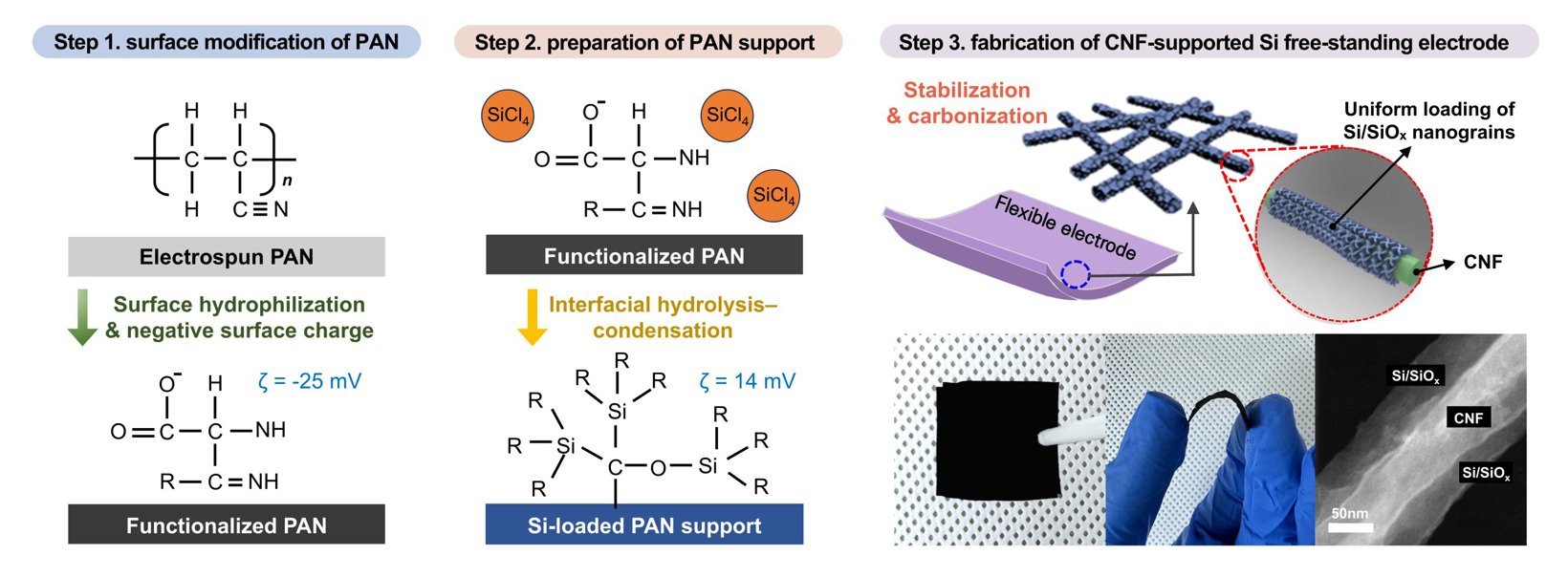
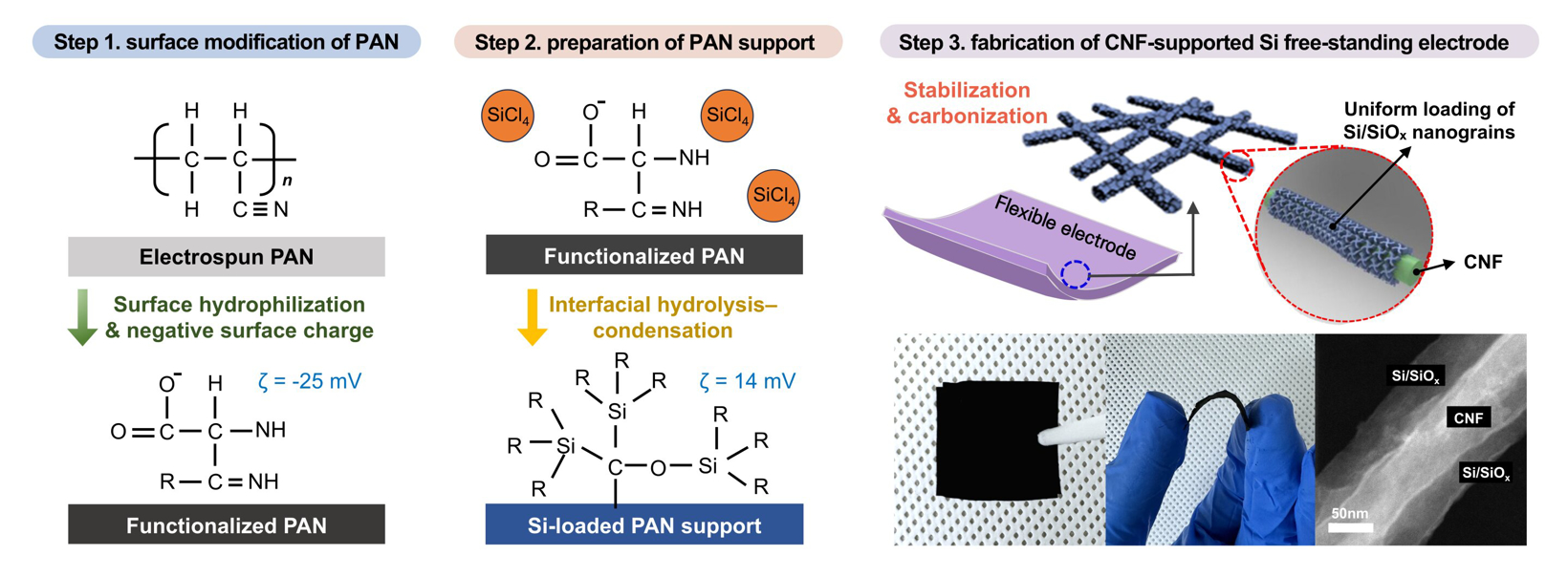
The Korean research team, publishing in Advanced Fiber Materials, abandoned the conventional slurry-coating approach entirely. Instead, they created a freestanding electrode where carbon nanofibers (CNF) serve as both structural scaffolding and conductive pathways.
How the Self-Supporting Architecture Works
- CNF Network: Carbon nanofibers form a 3D porous matrix that accommodates silicon’s volume changes without mechanical failure
- Conformal Si/SiOx Interface: Through hydrolysis-condensation reactions, researchers deposited silicon as a thin, continuous shell around each fiber rather than discrete particles
- Mechanical Integrity: Microscopy confirms no over-aggregation, maintaining ion transport channels even after thousands of expansion-contraction cycles
Performance Metrics That Matter for EVs
The electrochemical data reveals why this matters for electric vehicles:
- High Rate Capability: At 1A g⁻¹ current density (simulating fast charging), the anode maintained 79.8% capacity retention after 2,000 cycles
- Full Cell Validation: Paired with NCM622 cathodes (common in premium EVs), the system delivered 176.5 mAh g⁻¹ with 91.6% retention after 300 cycles
- Reduced Charge Transfer Resistance: Unlike conventional silicon anodes that degrade, this structure actually improves conductivity over time
See our analysis on CATL’s next-generation battery roadmap to understand how this compares to China’s dominant LFP and NCM technologies.
Implications for Western EV Supply Chains
For US and European markets, this breakthrough arrives at a critical inflection point. Chinese manufacturers currently control 70% of global battery cell production and are rapidly advancing their own silicon-anode research through giants like CATL and BYD.
The Fast-Charging Longevity Paradox Solved
Western automakers have faced a brutal trade-off: fast charging typically sacrifices battery longevity. The Sejong design simultaneously enables high-rate capability (1A g⁻¹) and extended cycle life, potentially allowing EVs to charge in under 15 minutes while maintaining warranties beyond 500,000 miles.
Manufacturing Scalability Questions
However, challenges remain. CNF production costs currently exceed standard copper foil current collectors used in conventional cells. As noted by BloombergNEF, transitioning from lab-scale fiber synthesis to gigafactory volumes requires capital-intensive carbonization infrastructure that may favor integration with existing Korean chemical giants like POSCO Chemical.
Competitive Landscape: The Global Race for Silicon Supremacy
This innovation places Korean research institutes alongside Silicon Valley startups like Sila Nanotechnologies and Group14 Technologies in the race to commercialize silicon-dominant anodes. Unlike vapor-deposition methods favored by US startups, Sejong’s solution uses wet-chemical processes that may align better with existing Asian battery manufacturing ecosystems.
The technology also presents strategic questions for Chinese EV leaders. Will Beijing accelerate partnerships with Korean material science firms, or double down on domestic solutions like CATL’s condensed battery technology? Nature Materials recently highlighted that Chinese firms hold 43% of global silicon-anode patents, suggesting intense competition ahead.
Conclusion: Is This the Tipping Point?
The Sejong University self-supporting silicon anode represents more than an academic curiosity—it demonstrates a viable pathway to 400+ Wh/kg battery packs without solid-state electrolytes. For Western investors monitoring the EV transition, the critical question is not whether silicon anodes will replace graphite, but whether supply chains can pivot fast enough to capture the value before Chinese competitors integrate similar innovations into mass-market vehicles.
As the industry moves toward 800V architectures and 350kW charging, structural innovations like CNF-supported anodes may prove more consequential than incremental cathode chemistry tweaks. The race is no longer just about who builds the biggest factory—it is about who masters the nanoscale architecture of the battery itself.