2026 Q1 ADAS Supplier Rankings: Local Giants Reshape China’s Auto Supply Chain

Is China’s automotive supply chain quietly becoming the world’s most advanced, leaving Western incumbents scrambling for relevance? New data from Gasgoo Auto Research Institute reveals a seismic shift in the first quarter of 2026: domestic Chinese suppliers now dominate over 92% of the air suspension market and are rapidly closing the gap in ADAS, lidar, and HD mapping. For Western investors and auto executives, this is not just a statistic—it’s a strategic pivot point.
Air Suspension: A Local Lockdown
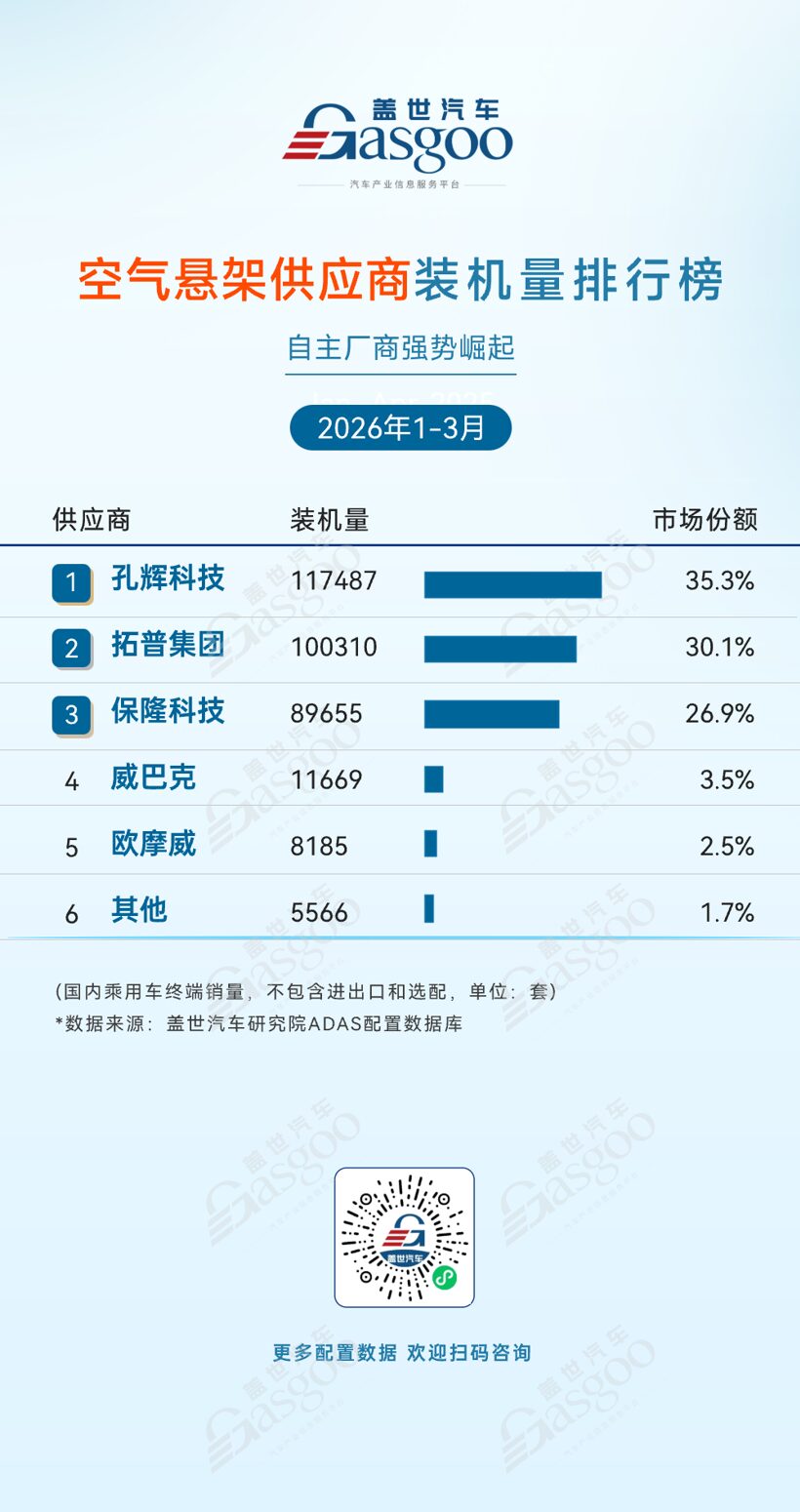
The air suspension segment tells the clearest story of indigenous dominance. In Q1 2026, three Chinese firms—Konghui Technology, Tuopu Group, and Baolong Technology—collectively installed over 307,000 units, capturing a staggering 92.3% market share. Konghui alone led with 117,487 units (35.3%), followed by Tuopu (100,310 units, 30.1%) and Baolong (89,655 units, 26.9%).
By contrast, traditional Western suppliers like Vibracoustic (11,669 units, 3.5%) and Oumowei (8,185 units, 2.5%) have been marginalized to niche roles. This echoes broader trends: local players have leveraged cost advantages, rapid iteration cycles, and deep integration with Chinese EV makers (BYD, NIO, Xpeng) to squeeze out foreign competitors.
ADAS and Perception Systems: The Next Battlefield
While global Tier 1 suppliers like Bosch, Continental, and Mobileye still lead in driving ADAS (L2+), front-view cameras, and automated parking, Chinese challengers are gaining ground fast. Hesai Technology and RoboSense have become the top lidar suppliers for Chinese EVs, with combined installations exceeding 200,000 units in Q1 2026, according to the Gasgoo report. AutoNavi and NavInfo dominate HD mapping, while Huace Navigation and BDStar Navigation lead in high-precision positioning.
This mirrors global coverage: Reuters recently reported that Chinese lidar firms are undercutting Western rivals by 30-50% on price while matching performance. Bloomberg highlighted that BYD’s DiPilot 100 system, which uses Chinese perception stacks, now rivals Tesla’s Autopilot in key metrics.
What This Means for Western Investors
The message is clear: the ‘China speed’ of innovation is accelerating a supply chain decoupling. Western OEMs (Tesla, VW, Ford) that rely on Chinese suppliers for cost-competitive components face a dilemma—deepen ties for access to cutting-edge tech, or risk losing the price war. Meanwhile, Western Tier 1 suppliers must either partner with Chinese firms or invest heavily in local R&D to stay relevant.
For portfolio managers, the takeaway is to monitor companies like Konghui Technology (private), Tuopu Group (601689.SH), and Hesai (HSAI) as bellwethers of this shift. The data suggests that by 2027, Chinese suppliers could command over 70% of the domestic ADAS component market, up from roughly 40% in 2024.
Conclusion: The New Normal
Q1 2026 data confirms that China’s core auto parts supply chain is undergoing a structural realignment. Local players are not just catching up—they are setting the pace. For anyone tracking the global EV race, ignoring these numbers is no longer an option.
See our analysis on How Chinese EV Supply Chains Are Outpacing Western Rivals.