Nanotin Layer Breakthrough: KERI’s Solution to Solid-State Battery Stability

Nanotin Layer Breakthrough: KERI’s Solution to Solid-State Battery Stability
Is the future of electric vehicles (EVs) about to be revolutionized by a new nanoscale tin layer technology? A recent breakthrough by the Korea Electrotechnology Research Institute (KERI) suggests that solid-state batteries, long hailed as the next generation of energy storage, may finally overcome their key commercialization hurdles.
The Challenge of Solid-State Batteries
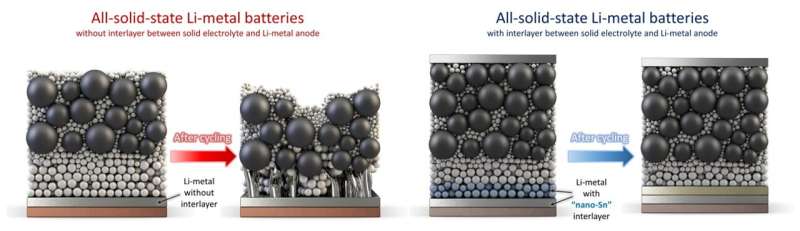
Solid-state batteries are often referred to as the ‘ideal battery’ due to their significantly reduced fire risk and higher energy density. However, one of the primary challenges in bringing these batteries to market is the issue of interface instability between the lithium metal anode and the solid electrolyte. This instability can lead to increased resistance and the formation of dendrites, which can shorten the battery’s lifespan.
KERI’s Nanotin Layer Technology
In a groundbreaking study published in Advanced Energy Materials, a research team led by Dr. Nam Ki-Hun at KERI has developed a novel nanotin (Sn) interlayer technology. This thin layer, composed of nanoscale tin powder, is designed to address the interface instability problem. The nanotin layer, which has a strong affinity for lithium, is applied to the surface of the lithium metal anode using a transfer printing process. This layer not only reduces the physical damage to the lithium metal but also serves as an efficient ion transport channel, significantly lowering the overall resistance of the battery.
Key Findings
- High Capacity Retention: The researchers tested the technology in a pouch cell, and even under a low pressure of 2 MPa, the battery maintained over 81% of its capacity after 500 cycles.
- Enhanced Energy Density: The battery achieved an energy density of over 350 Wh/kg, surpassing the typical range of 150-250 Wh/kg for conventional lithium-ion batteries.
- Cost and Weight Efficiency: Unlike traditional methods that rely on high external pressures or expensive coatings, this nanotin layer does not add significant weight or cost to the battery system, making it a more viable solution for commercial applications.
Implications for the EV Industry
This breakthrough could have profound implications for the EV industry. By addressing the key technical challenges of solid-state batteries, KERI’s nanotin layer technology paves the way for more reliable and high-performance energy storage solutions. This could accelerate the adoption of EVs and potentially reduce the cost and complexity of battery systems, making them more accessible to a broader market.
For Western investors and auto industry professionals, this development is particularly significant. It provides a clear signal that the Chinese and South Korean markets are at the forefront of battery innovation, and staying informed about these advancements is crucial for maintaining a competitive edge.
See our analysis on Chinese EV Battery Innovation for more insights into the latest technological trends.
Conclusion
The nanotin layer technology developed by KERI represents a significant step forward in the commercialization of solid-state batteries. By overcoming the critical challenge of interface instability, this innovation could unlock the full potential of solid-state batteries, driving the next wave of EV advancements. As the global race to develop better battery technologies continues, staying ahead of the curve with the latest insights from TheSinoReport.com is essential for anyone looking to capitalize on the rapidly evolving EV landscape.