Ford Weather Detection Patent: Crowdsourced ADAS Strategy vs. Tesla and Chinese EVs
Ford Weather Detection Patent: Crowdsourced ADAS Strategy vs. Tesla and Chinese EVs
What if your vehicle could predict black ice three blocks before you hit it—not through lagging satellite feeds, but through real-time data pulsed from the tires of a Ford F-150 ahead of you? This is not speculative fiction. Ford Motor Company recently filed USPTO Patent 12601854, a weather detection system that leverages crowdsourced sensor fusion to create hyperlocal environmental maps, potentially leapfrogging Tesla’s vision-only approach while answering the sensor-rich strategies of Chinese EV giants like BYD and NIO.
The Patent Anatomy: Decoding USPTO 12601854
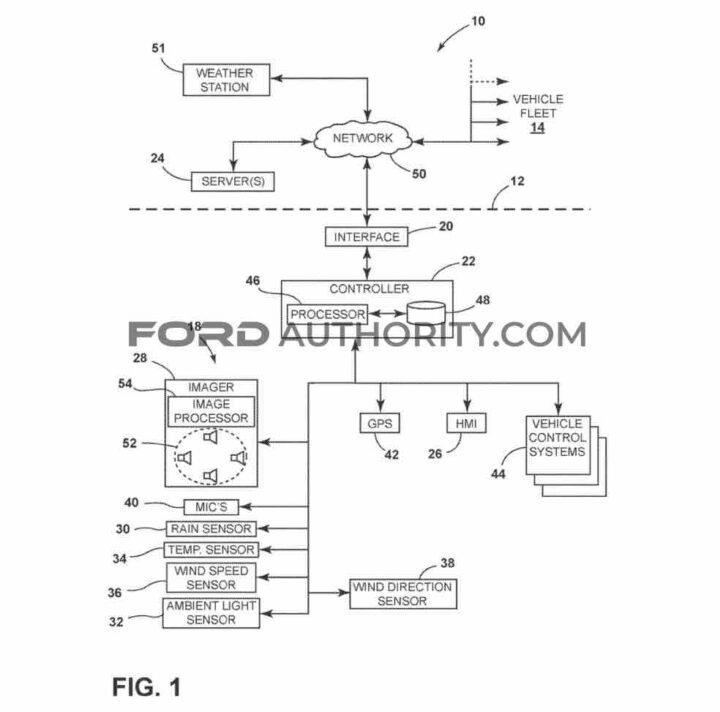
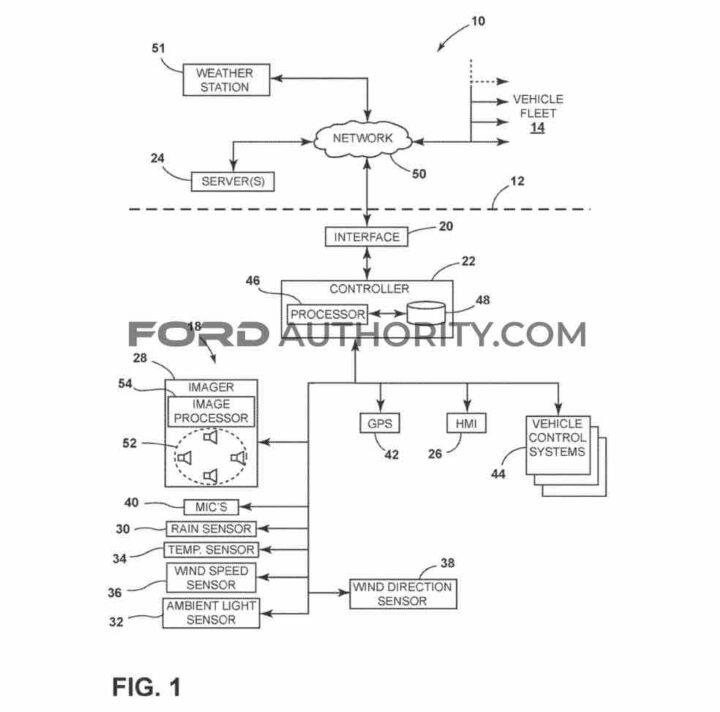
Filed November 3, 2023, and published April 14, 2026, Ford’s patent describes a sophisticated network of environmental sensors that do more than detect rain or temperature—they communicate. The system architecture includes:
- Environmental Sensors: Deployed across the vehicle fleet to capture micro-climate variations invisible to traditional weather stations
- Network Interface: A vehicle-to-vehicle (V2V) and vehicle-to-cloud (V2C) communication layer that aggregates data from thousands of participating vehicles
- Control Circuit: An AI-driven processor that cross-references sensor readings against fleet-wide data to detect sensor malfunctions and validate environmental conditions
- Actuator Response: Automatic adjustment of suspension, braking, and ADAS parameters based on verified road conditions
Why Crowdsourcing Changes the Game
Traditional automotive weather systems rely on meteorological services that generalize conditions over square miles. Ford’s approach recognizes that temperature and precipitation can vary significantly within mere meters—a critical insight for autonomous navigation. By rewarding data-sharing drivers (potentially via subscription credits or charging incentives), Ford aims to solve the data sparsity problem that plagues hyperlocal weather modeling.
See our analysis on Tesla’s vision-only approach to environmental perception to understand how legacy automakers are pivoting toward sensor redundancy.
The Geopolitical Tech Stack: Detroit vs. Shenzhen
While Western media fixates on battery costs and tariffs, the real battleground in the Chinese EV market is environmental perception. BYD’s Yangwang U8 and NIO’s ET7 utilize LiDAR-heavy sensor fusion to navigate extreme weather conditions common in Asia’s subtropical climates. Ford’s patent represents Detroit’s counter-move: instead of expensive hardware arms races, deploy software-defined networks that monetize existing sensor infrastructure.
The Investment Implications
For Western investors tracking the automotive semiconductor sector, this patent signals a strategic pivot. Ford is essentially building a data moat—similar to how Waymo crowdsources mapping data—but through production vehicles rather than test fleets. This reduces the capital intensity required to train autonomous systems while creating a recurring revenue stream via weather data subscriptions for logistics and insurance partners.
Critical Analysis: Red Flags and Opportunities
Despite the innovation, Ford’s filing contains standard corporate hedging: the patent represents a concept, not a product roadmap. However, the timing—filing amid China’s push for L3 autonomy standards—suggests Ford recognizes that sensor fusion, not just computer vision, will define the next decade of ADAS differentiation.
The system also addresses a vulnerability in current Level 2 systems: sensor degradation during adverse weather. By cross-referencing individual sensor failures against fleet data, Ford vehicles could maintain ADAS functionality even when individual units ice over or malfunction—a redundancy critical for European winter markets and the competitive Chinese EV landscape.
Bottom Line for Investors
Ford’s weather detection patent is not merely about convenience—it is about creating the infrastructure for Level 4 autonomy without the $50,000 sensor suites. As Chinese EV makers like XPeng and Zeekr advance their own crowd-mapping capabilities, Ford’s intellectual property in sensor validation and V2V communication could become a licensable asset, not just a feature. For investors, this represents a rare example of legacy Detroit IP innovation that answers the software-defined vehicle challenge from Shenzhen.